
Indiana Business Name Availability Checker
Data verified August 3, 2026 · Official database: Indiana Secretary of State Business Services Division
LLC filing fee
Name reservation cost
Reservation hold
Quick answer: Indiana runs one register for every filing entity. § 23-0.5-3-1 of the Uniform Business Organizations Code requires a new name to be distinguishable from domestic entities active or dissolved less than 120 days, foreign entities registered here, reserved names, and registered assumed business names, all on the same Secretary of State records. The Business Search shows that register at work: its results carry a Name Type column that labels each row LEGAL NAME, FORMER NAME or FOREIGN LEGAL NAME, so the record blocking you may be a name a company used to have. Written consent can clear a conflict, with one exception the statute spells out: consent may never release a reserved name.
How to check a name in Indiana
The checker above is the fast first pass. The four screens below follow the Secretary of State’s Business Search, the public window on the records INBiz files into. Two things set this portal apart: it puts a reCAPTCHA in front of the search itself, and it opens on Contains, the widest of its match modes, where most states make you find that setting on your own. What you find is preliminary. The Business Services Division decides the name when it reviews your Articles of Organization.
Step 1: Open the Business Search and clear the reCAPTCHA
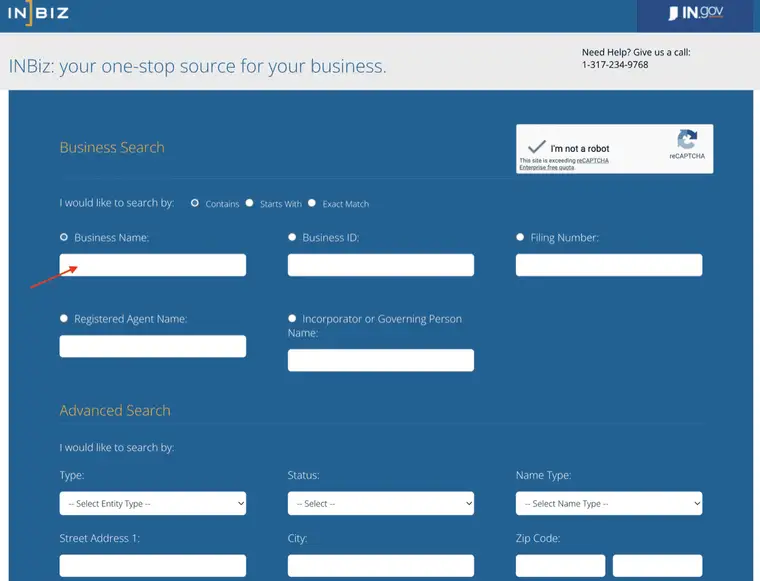
Open the Business Search. Indiana asks you to tick I’m not a robot before it will run anything, so do that first. I would like to search by offers Contains, Starts With and Exact Match, and the form arrives with Contains already selected. You can search by Business Name, Business ID, Filing Number, Registered Agent Name or Incorporator or Governing Person Name, and an Advanced Search below adds filters for entity type, status, name type and address.
Step 2: Type the distinctive words, without the ending
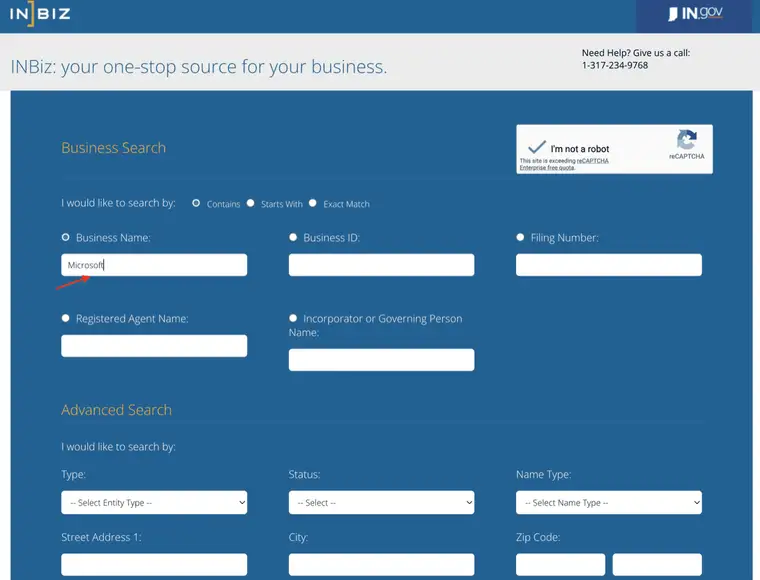
Type the words that make your name yours into Business Name, leaving off “LLC”, because § 23-0.5-3-1 disregards entity-type words when it compares names. “Acme LLC” against “Acme Inc.” is a match here. Contains is already the widest setting, so one search does the work that takes two passes on portals that open narrower. Keep Exact Match for confirming a single record you already know.
Step 3: Read the Name Type column on every row
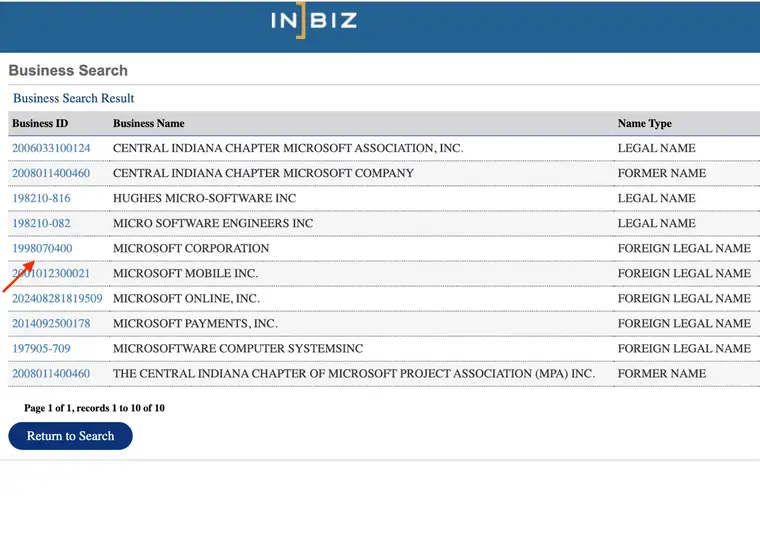
The results are three columns: Business ID, Business Name and Name Type. The third is the one to read carefully. In this capture the rows split across LEGAL NAME, FORMER NAME and FOREIGN LEGAL NAME, and the count line reads “records 1 to 10 of 10.” A FORMER NAME row means a company that renamed itself is still on the register under its old name, and a FOREIGN LEGAL NAME row is an out-of-state company registered to do business here. Both sit in the records your name is screened against, so a row of either type with your words in it deserves a click.
Step 4: Open the record, then check its Assumed Name History
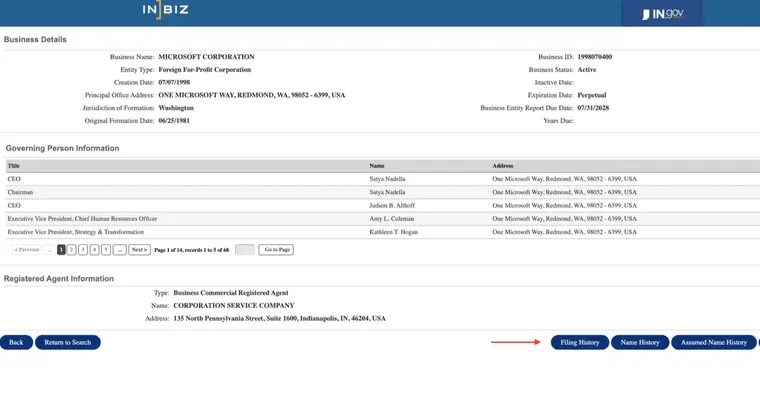
Business Details shows Entity Type, Business Status, two dates worth telling apart (Creation Date is when the company registered in Indiana, Original Formation Date is when it was born in its home state), Jurisdiction of Formation, and the Business Entity Report Due Date that Indiana entities file against every two years. The record in this capture reached Indiana in 1998, seventeen years after its 1981 formation in Washington. Three buttons at the bottom finish the job: Filing History, Name History and Assumed Name History, the last one listing DBAs the entity has registered, which block later names just as its legal name does.
Indiana LLC naming rules
The suffix rule is in § 23-18-2-8 of the Business Flexibility Act, and the availability rules are in § 23-0.5-3-1 of the Uniform Business Organizations Code:
- Required ending: “limited liability company,” “L.L.C.” or “LLC.” Indiana does not offer the “limited company” or “LC” variants some states allow.
- One register, five kinds of record: the name must be distinguishable from every domestic filing entity, every foreign entity registered in Indiana, every name reserved under the current or prior statutes, and every registered assumed business name.
- Dissolution has a countdown: a dissolved company’s name stays blocked for 120 days after dissolution, then becomes available.
- Entity-type words do not count: “corporation,” “Inc.,” “company,” “Co.,” “LLC,” “LP” and the like are disregarded in the comparison, so swapping the ending never clears a conflict. The flip side: if the ending is the only difference, no consent is needed at all.
- Consent, with one exception: the holder of a conflicting name can consent in a record satisfactory to the Secretary of State, but consent may not be given for a reserved name.
- No general banned-word list, but a government line: the one express prohibition is language falsely implying a connection with a government agency. “Bank,” “banking” and “trust” are policed separately by the Department of Financial Institutions, and “insurance” by the Department of Insurance.
Reserving a name in Indiana
A reservation is $10 filed through INBiz and holds the name for 120 days.
Two features make Indiana’s version unusually strong for the price. The hold renews for successive 120-day periods, so it can be extended rather than expiring on a fixed date. And a reserved name is the one record on the register that consent cannot release: § 23-0.5-3-1 lets the holder of any other conflicting record wave a newcomer through, but not the holder of a reservation. The reservation can also be transferred to a company or other organization by signed notice. The statute frames the filing as an electronic application; the paper form 26233 with its $20 fee predates the current code.
DBAs in Indiana
Indiana splits its assumed-name system down the middle, and the split decides what the state search can show you.
An LLC or corporation files its Certificate of Assumed Business Name with the Secretary of State through INBiz, at $20 online or $30 by mail, under § 23-0.5-3-4. That certificate never expires, joins the state entity records, and screens against later names, which is why the detail screen above has an Assumed Name History button. A sole proprietor or general partnership instead records its certificate with the county recorder in each county where it does business, unless the business name contains the owner’s surname. Those county records are not centrally indexed and never appear in the state search, so a clear result here says nothing about the sole proprietor trading under the same name two counties over.
If your Indiana name is taken
- Check the Name Type of the blocker first. A FORMER NAME row is a company that moved on, and its current legal name may leave your words free; a FOREIGN LEGAL NAME row is an out-of-state company you cannot negotiate around by waiting.
- A new ending changes nothing. Entity-type words are disregarded, so “Acme LLC” against “Acme Inc.” is the same name. But if the ending really is the only difference, you need no consent at all.
- If the company just dissolved, wait it out. The name stays blocked only for 120 days after dissolution, a shorter shadow than most states cast.
- Consent works, except against a reservation. Any record holder can consent in writing, but the statute bars consent for a reserved name, so a reservation can only be waited out or transferred to you by its holder.
- Look under Assumed Name History. The conflict may be a DBA the entity registered rather than its legal name, and a discontinued assumed name stops blocking once its notice of discontinuance is filed.
If the search comes back clear, you can start your Indiana LLC with that name. The Articles of Organization are $95 filed online through INBiz ($100 on paper), and the ongoing obligation is a Business Entity Report every two years, the due date printed on the company’s own record.
Official Indiana sources
- Business Search: the Secretary of State’s entity records
- INBiz: the state’s filing portal for reservations, formations and assumed names
- Ind. Code § 23-18-2-8: the required LLC ending
- Ind. Code § 23-0.5-3-1: distinguishability, the five record classes, consent and its reserved-name exception
- Ind. Code § 23-0.5-3-3: the renewable 120-day reservation and its transfer
- Ind. Code § 23-0.5-3-4: assumed business names, state and county lanes
Frequently asked questions
How do I check business name availability in Indiana?
Search the Secretary of State's Business Search, which INBiz links from its business services. Tick the reCAPTCHA box first, since Indiana gates the public search behind it. The form opens on Contains, the widest of its three match modes, so the first pass already surfaces records that hold your words in the middle of a longer name. What you find is preliminary; the Business Services Division rules on the name when it reviews your filing.
What does Indiana compare my LLC name against?
One register covering every filing entity. Ind. Code § 23-0.5-3-1 requires the name to be distinguishable from every domestic filing entity that is active or dissolved less than 120 days, every foreign entity registered in Indiana, every reserved name, and every registered assumed business name. Entity-type words are disregarded in the comparison, so "Acme LLC" does not clear "Acme Inc."
How much does it cost to reserve a business name in Indiana?
The reservation is $10 filed through INBiz and holds the name for 120 days. Indiana lets you renew it for successive 120-day periods, so the hold can outlast the single fixed window most states sell. The statute frames the filing as an electronic application; the old paper form 26233 carried a $20 fee and predates the current code.
Do Indiana DBAs show up in a business name search?
The ones that can block you do. Assumed business names adopted by LLCs and corporations are filed with the Secretary of State, sit in the same records as the entities, and appear in the search. Assumed names recorded by sole proprietors and general partnerships live at each county recorder's office instead, are not centrally indexed, and do not appear in the state results.
Can I use a name that is already taken if the owner agrees?
Usually. Indiana accepts the other holder's consent delivered in a record satisfactory to the Secretary of State, and no consent is needed when the only difference is the entity-type word. The one hard stop is a reserved name: § 23-0.5-3-1 says consent may not be given for the use of a reserved name, so a $10 reservation is the strongest hold on this register.