An independent business name search service,
not a government website.How our checks work
We run preliminary name checks against state business records to help you
see whether a name appears to be taken before you file. Only the official
Secretary of State database is authoritative, and we link to it on every
result so you can verify for yourself. Some links on this site are
affiliate links; see our disclosure.
Most states let you hold a business name for a fee before you file anything else. The
price, the length of the hold, and whether you can renew it all change at the state line.
This page compares what we have verified against state statutes and fee schedules for
51 states.
The short version
A reservation holds a name. It does not create your business and it is not an approval.
Georgia's Secretary of State puts the point bluntly in its own guidance: no activity or
investment under a name, such as advertising or entering legal transactions, should be
conducted on the strength of a reservation. If you are filing your formation documents
soon, filing secures the name by itself and the reservation fee adds nothing. Reserving
earns its cost when something real stands between you and filing, such as waiting on a
partner, a licence, or funding.
$10–$100
Reservation cost range
30–180
Days the hold lasts
51
States verified
What you pay and how long it holds
The published filing fee tells you little, for two reasons. It buys a different amount of
time in every state, and in some states it is not the amount you actually pay. Every figure
below is the real out-of-pocket cost on the normal filing path.
Georgia costs $35 for 30 days, which works out to $1.17 per
day held. Arizona costs
$10 for 120 days, or
$0.08 per day. That is a
14-fold difference in what
a day of hold costs.
Where the sticker price is not the price
6 states on this page charge more than the fee their statute names. Alabama: $25 becomes
$28.
Georgia: $25 becomes
$35.
Minnesota: $35 becomes
$55.
Nebraska: $25 becomes
$30.
2 more are flagged in the table. The comparison on this page uses the real total, not the filing fee.
One worked example of that gap. Georgia's official page is typical: read the fee section
and the real cost is stated plainly, even though it is higher than the fee the statute
names.
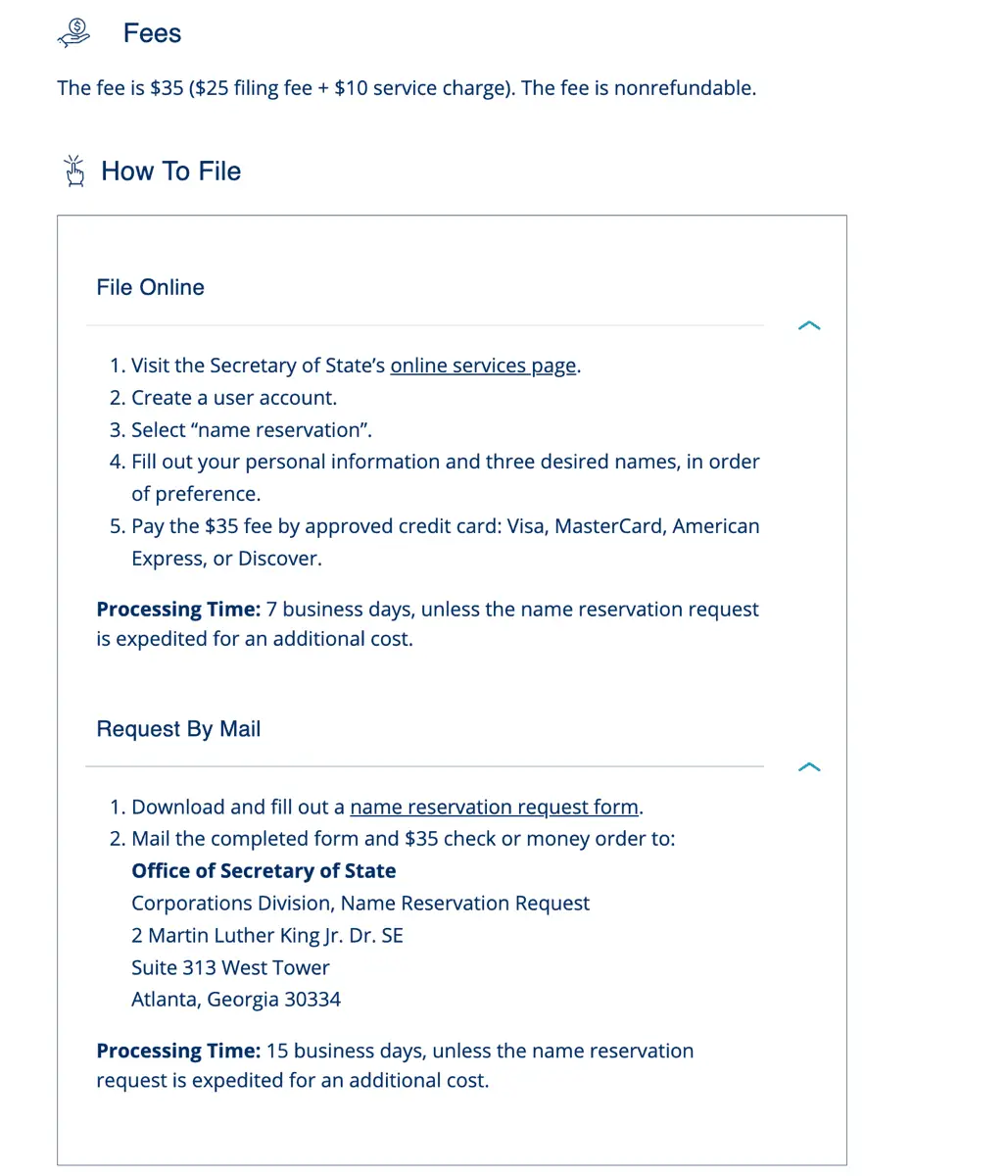
Example: Georgia's official page states the reservation costs $35, not the $25 its
statute names, and charges the same online or by mail. Most states publish their real
cost this plainly once you open the fee page. Source:
Georgia Secretary of State, How to Reserve a Name
. Captured 2026-07-17.
30 days: GA, MD·60 days: CA, MA, MO, NY, OK·90 days: IL, NV·120 days: AK, AZ, AR, CO, CT, DE, DC, FL, HI, IN, IA, KS, KY, LA, ME, MT, NE, NH, NJ, NM, NC, OR, PA, RI, SC, SD, TX, UT, VT, VA, WV, WI, WY·180 days: MI, MS, OH, WA
How long the hold lasts, with the states on each clock. Fees and cost per day are in the
table below. Source: state statutes and Secretary of State fee schedules, verified
2026-08-06.
Until the end of the sixth full calendar month after the month of filing (LARA's own page rounds this to 180 days; re-reservable by filing another application and fee)
Cost per day is our calculation: the real out-of-pocket cost divided by the days the hold
lasts. "You actually pay" adds service charges and card fees to the filing fee where a
state applies them, so the states can be compared on the same basis. Only the linked
official sources are authoritative, and fees change.
When reserving is worth the fee
Reserving usually earns its cost
Weeks stand between you and filing, and the name matters to you.
You are waiting on a partner, a licence, or funding before you can file.
You are printing signage or packaging before the entity exists.
Your name is generic enough that someone else could plausibly file it.
Reserving usually buys nothing
You are filing your formation documents in the next few days.
You want trademark protection. A reservation gives none.
You want the name in more than one state. Reservations are per state.
You are still deciding between names and have not checked availability.
The patterns that catch people out
The fee table hides the rules that actually change decisions: service charges on top of
the fee, paper-only filing, and whether the clock can be restarted. Four examples cover
the patterns; each state's own page tells its full story.
The statute names $25, the office charges
$35, and the fee is kept even
when the name is rejected. Processing runs 7 business days online and 15 by mail
against a 30 day hold, so much of the period is spent waiting for the reservation
itself.
$10 buys 120 days, filed
online through Hawaii Business Express, with a $25 expedite if review needs to move
faster. At $0.08 per day held, it is the floor of the
national range.
Most states run the clock once. Colorado lets the hold renew for another
$25 online, and Texas renews on
Form 501, where paying by card adds 2.7 percent to the
$40 fee. Renewability changes the
strategy: a renewable hold can bridge a long gap that a single term cannot.
Form NR is printed, signed, and mailed or faxed, and its instructions say plainly
that the reservation is not a name registration. A new reservation submitted before
the current one expires is rejected, which closes the back-to-back renewal path
other paper states leave open.
Where this comes from
Every fee and hold period on this page is read from the statute or the official fee
schedule of the state it describes, never from a secondary source, and the newest
verification pass ran on 2026-08-06. The table's Statute column links each state's
primary law under its own citation, and the full per-state source list, with access dates, lives on that state's
own page under its official sources section.
Questions
Does reserving a name mean the state approved it?
No. A reservation holds a name against later filings for a set period. It is not an approval of the name and it does not create your business. The state makes its final decision when you file your formation documents, and it can still refuse the name at that point.
Do I have to reserve a name before forming an LLC?
No state requires it. Reservation is optional in every state on this page. If you are filing your formation documents within the next few days, the reservation fee usually buys you nothing, because filing itself secures the name.
What happens when a reservation expires?
The name returns to the available pool and anyone can file it. Some states let you reserve the same name again after a gap; others treat the reservation as non-renewable. The comparison table links each state's own page, which records which rule applies where we have verified it.
Is a reserved name protected as a trademark?
No. A name reservation only affects that one state business registry. It gives you no trademark rights, no rights in other states, and no protection against a business using a similar name outside the registry.
Do I get the fee back if the name is rejected?
Generally not. Georgia states plainly that the fee is nonrefundable and that the filing fee still applies when the requested name is unavailable, though it will let you submit another request without paying again. Check the state page before assuming a rejected request costs you nothing.
Does the hold really last the full period?
Not in practical terms, because the clock starts at filing while the state is still processing. Georgia publishes 7 business days for an online reservation and 15 business days by mail against a 30-day hold, so a large part of the period is spent waiting for the reservation itself.
A reservation holds a name. Filing is what secures it.
Check whether your name looks free first, then decide whether to hold it or file for it.