
New York Business Name Availability Checker
Data verified July 25, 2026 · Official database: New York Department of State
LLC filing fee
Name reservation cost
Reservation hold two 60-day extensions
Quick answer: New York’s own database prints the warning most states leave unsaid. Above the search form of the Department of State’s Corporation and Business Entity Database sits the line “This system should not be used to determine the acceptability of an Entity Name.” Read it literally. The index is worth searching, and it will not settle your name, because N.Y. LLC Law § 204 is applied when your Articles of Organization are reviewed and a long list of words needs another agency’s consent before that.
How to check a name in New York
The checker above is your quick first pass. The four screens below follow the Department of State’s Corporation and Business Entity Database, which covers corporations, LLCs, limited partnerships and, usefully, the assumed names those entities have filed. The form has two settings that change what you see, and both default against you. Whatever the screen shows is preliminary; the Department of State decides the name at filing.
Step 1: Read the form's own labels carefully
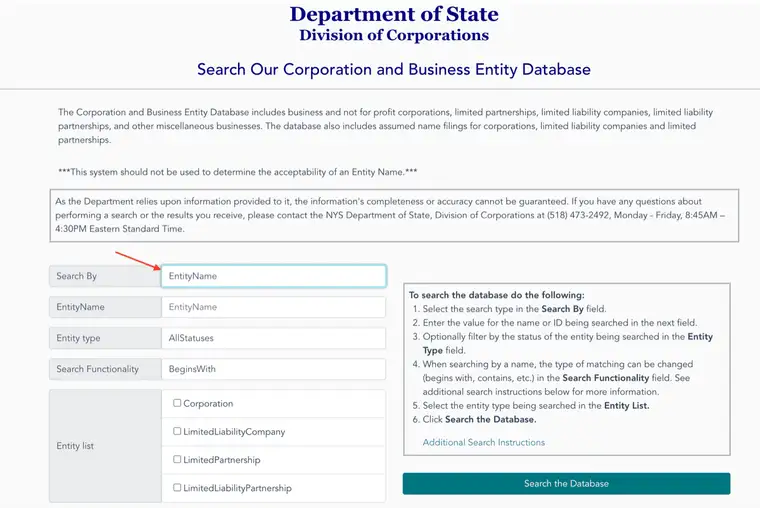
Open the entity database. It opens with Search By set to EntityName, which is what you want, and states its own limits above the fields: the department “relies upon information provided to it,” so completeness and accuracy are not guaranteed. One label misleads. The field marked Entity type holds AllStatuses, and the instruction panel confirms it filters by status; the actual entity type is chosen lower down in Entity list with the Corporation, LimitedLiabilityCompany, LimitedPartnership and LimitedLiabilityPartnership checkboxes. For a name check, leave both alone.
Step 2: Widen the match before you search
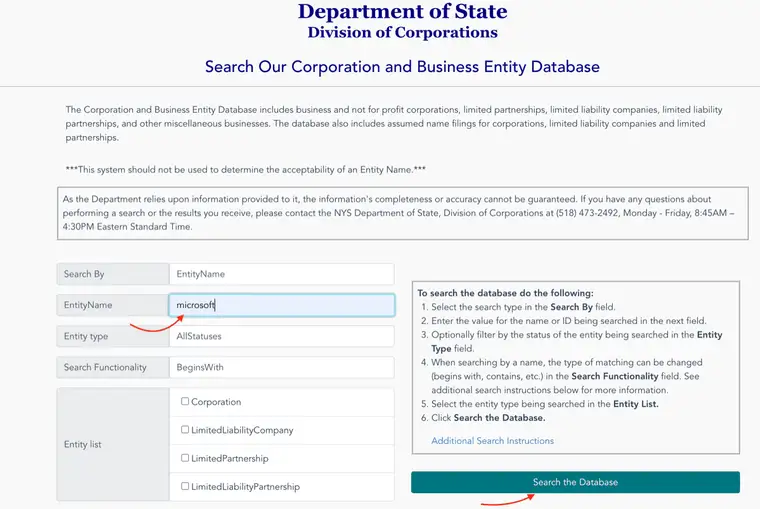
Type the distinctive words into EntityName without an ending. Then look at Search Functionality, which arrives set to BeginsWith. That match only finds names that open with your words, so a conflict sitting in the middle of a longer name stays hidden. Change it to a contains-style match and run the search again. Choose Search the Database.
Step 3: Raise the rows per page, then read the county
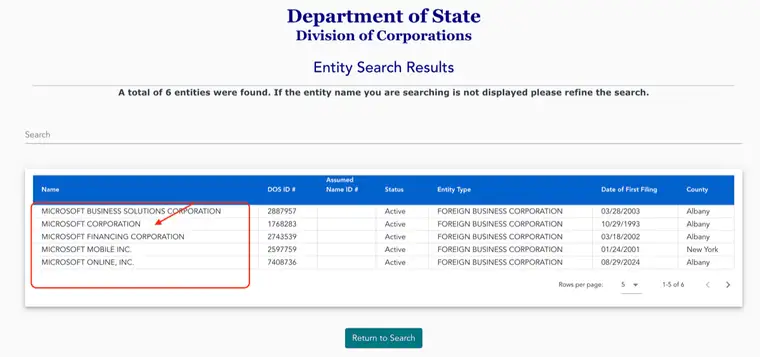
The results open with a count and a caution: “A total of 6 entities were found. If the entity name you are searching is not displayed please refine the search.” Note the trap in that screen. Rows per page defaults to 5, so the footer reads 1-5 of 6 and the sixth match is on a page most people never open. Raise it first. The columns are Name, DOS ID #, Assumed Name ID #, Status, Entity Type, Date of First Filing and County. The assumed-name column tells you a row is a trading name rather than an entity, and County matters later, because it decides where a new LLC has to publish.
Step 4: Open the record and its four histories
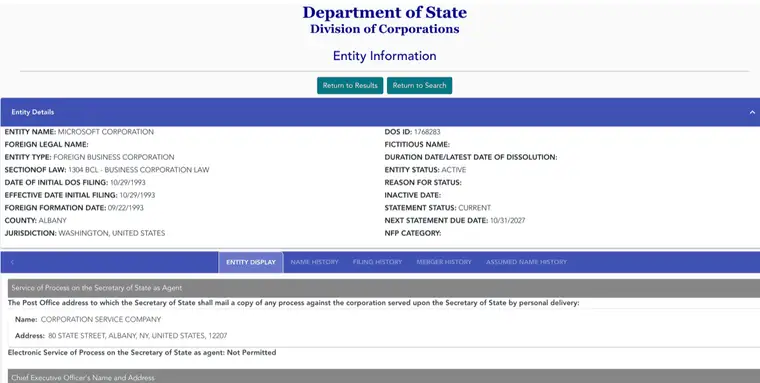
Entity Information gives ENTITY NAME, ENTITY TYPE, SECTION OF LAW, COUNTY, JURISDICTION, DOS ID, ENTITY STATUS, and a FICTITIOUS NAME field that fills in when a foreign company had to adopt a different name to register here. STATEMENT STATUS and NEXT STATEMENT DUE DATE track the biennial filing. Below sit four history tabs: NAME HISTORY, FILING HISTORY, MERGER HISTORY and ASSUMED NAME HISTORY. On a close match, open the first and the last, because a company may sit near your words under a former or a trading name.
New York LLC naming rules
The rules sit in N.Y. LLC Law § 204:
- Required ending: “Limited Liability Company” written in full, or “L.L.C.” or “LLC.”
- Distinguishable across the whole index: the comparison runs against domestic and authorized foreign LLCs, corporations and limited partnerships, against the fictitious names those entities use here, and against reserved names.
- Words another agency must approve first. This is where New York differs most, and the list is sorted by who signs off. “Bank,” “trust,” “insurance,” “finance,” “loan,” “mortgage,” “savings,” “investment,” “annuity,” “attorney” and “lawyer” need the Superintendent of Financial Services. “School,” “education,” “college,” “university,” “academy,” “institute,” “museum” and “library” need the Commissioner of Education. “Blind” and “handicapped” need the Department of Social Services, and “exchange” needs the Attorney General.
- Words nobody can approve: “board of trade,” “chamber of commerce,” “corporation,” “incorporated,” “partnership,” “state police,” “state trooper” and “urban development” are unavailable outright.
- The consent step is a schedule item, not a formality. A restricted word means an approval has to arrive before the Articles of Organization can be filed, so a name that looks clear on the index can still add weeks.
Reserving a name in New York
New York’s hold is short but stretchable. A reservation is $20 for 60 days, and it can be extended twice, 60 days at a time, for another $20 each. The most you can hold a name is 180 days for $60, which reaches the same place as Washington’s single 180-day hold by a different route: you pay in stages and only keep paying if your plans keep slipping.
That structure fits New York’s other timing problem. A restricted word needs another agency’s consent before filing, and the reservation is what keeps the name from moving while you wait for it.
Assumed names in New York
An LLC that trades under anything other than its true legal name files a Certificate of Assumed Name with the Department of State under General Business Law § 130. The state fee is $25, plus a per-county charge for each county the certificate lists, so the real cost tracks how widely you operate. Sole proprietors and general partnerships do not use this route at all; they file with the clerk of each county where they do business.
The certificate does not expire. It runs until amended or cancelled, and a certified copy has to be displayed at the premises. What it does not do is give you the name: the distinguishability protection New York offers attaches to the LLC’s true legal name, not to the assumed one. The practical value for a name check runs the other way. Because entity assumed names are in the same database you just searched, with their own Assumed Name ID # column, they are visible to you. County certificates are not.
If your New York name is taken
- Confirm you saw every result. With rows per page at five, a six-row result set hides one match. Re-run wide before you conclude anything.
- Check the restricted list before redrafting. Reaching for “capital,” “investment” or “institute” to differentiate can turn a naming problem into a consent problem with another agency.
- Read the histories, not just the row. A company that changed its name, merged, or filed an assumed name can conflict with words the results table never displays.
- Remember what the database says about itself. It is not the acceptability test, so a marginal difference you talk yourself into can still be refused at filing.
If the index reads clear, you can start your New York LLC with that name. Budget for what comes after the $200 filing: within 120 days the LLC must publish in two newspapers for six consecutive weeks in its county, then file a Certificate of Publication for $50.
Official New York sources
- Corporation and Business Entity Database: the Department of State’s entity and assumed-name index
- N.Y. LLC Law § 204: the LLC name and distinguishability rule
- N.Y. LLC Law § 205: the 60-day reservation and its extensions
- General Business Law § 130: certificates of assumed name
- Application for Reservation of Name: the $20 filing
- Certificate of Assumed Name: the $25 filing plus county fees
- Certificate of Publication: the $50 filing after six weeks of notices
Frequently asked questions
How do I check business name availability in New York?
Search the Department of State's Corporation and Business Entity Database, entering your words under EntityName and switching Search Functionality from BeginsWith to a broader match. Raise the rows-per-page setting before you read the results, because it defaults to five and a sixth match sits on the next page. The database itself carries a warning that it should not be used to decide whether an entity name is acceptable, so treat a clear screen as a starting point.
Why does New York say its own database cannot tell you if a name is available?
Because acceptability depends on more than what is on the index. The Department of State reviews the name against its distinguishability standard when the Articles of Organization arrive, and a long list of restricted words needs another agency's consent first. The database also notes that it relies on information provided to it, so completeness and accuracy are not guaranteed. It is a records search, not a ruling.
How much does it cost to reserve a business name in New York?
A reservation is $20 for 60 days, and it can be extended twice for 60 days each at $20 per extension, so the longest hold is 180 days for $60. That structure suits a filing you expect to make soon and lets you extend only if plans slip. Forming the LLC is a separate $200, and the biennial statement afterwards is $9.
Do I have to publish a notice when I form a New York LLC?
Yes. Within 120 days of formation a New York LLC must publish a copy of its Articles of Organization or a formation notice in two newspapers for six consecutive weeks, in the county named in the Articles, then file a Certificate of Publication for $50. The newspapers are designated by the county clerk, which is why the county on a record matters more in New York than in most states.
Are assumed names included in the New York entity search?
Assumed names filed by LLCs, corporations and limited partnerships are, and the results table gives them their own Assumed Name ID column. Certificates filed by sole proprietors and general partnerships go to the county clerk instead and never reach the state database, so a clean state search does not rule out someone trading under your words locally.