
Pennsylvania Business Name Availability Checker
Data verified August 10, 2026 · Official database: Pennsylvania Department of State
LLC filing fee
Name reservation cost
Reservation hold non-renewable
Quick answer: Pennsylvania is in the middle of a transition that makes names harder to free here than anywhere else in this guide. Act 122 of 2022 repealed the decennial report on January 3, 2023, and the annual reports and administrative dissolutions that replace it do not take full effect until 2028, so the Department of State’s own name availability page describes the years in between as constricted: hundreds of thousands of records sit “active” having filed nothing in decades, and each one still blocks its name. The search is also honest about its own lag, printing the date through which filings have been processed.
How to check a name in Pennsylvania
The checker above is the fast first pass. The four screens below follow the Department of State’s filing search, which is the plainest interface in this guide: one box, one button. The complexity in Pennsylvania is not in running the search, it is in reading what a match means, because a live-looking record and a genuinely trading company are further apart here than in most states. What you find is preliminary. The Bureau of Corporations and Charitable Organizations rules on the name when your Certificate of Organization is examined.
Step 1: Open the Department of State business search
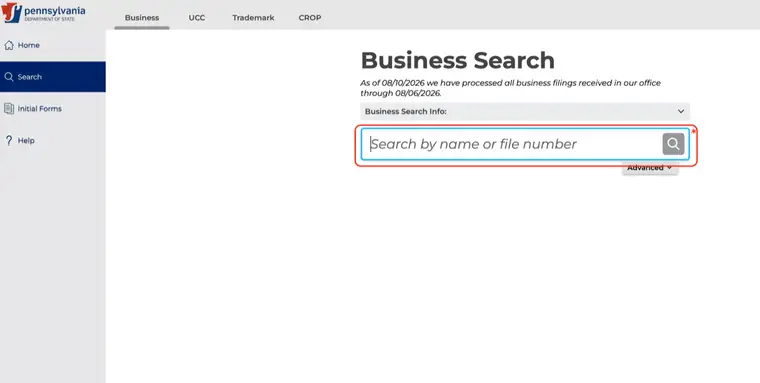
Open the business search. Four tabs run across the top, Business, UCC, Trademark and CROP, and entity names live under the first. The sentence under the heading is the one to read before anything else: on the day of this capture it said filings had been processed through 08/06/2026, four days earlier. A company that filed this week is not in the index yet, so the search cannot rule it out. The Business Search Info panel above the box expands into the Department’s own notes on scope.
Step 2: Type the distinctive words in the single search box
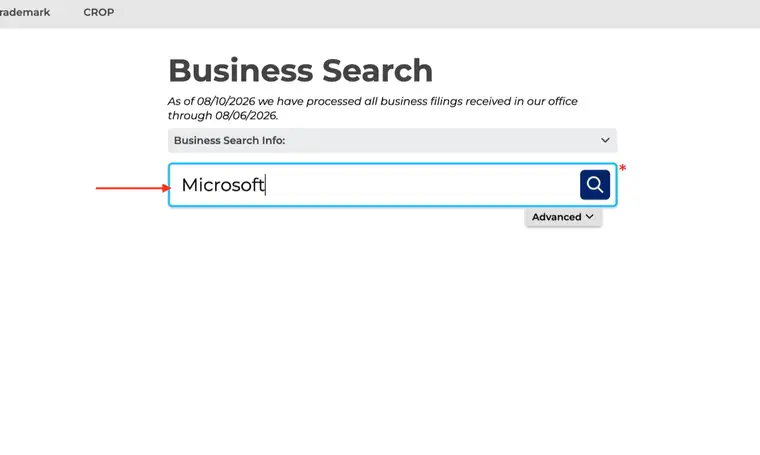
The placeholder reads Search by name or file number, so the same field does both jobs. Type the distinctive words and leave off the ending: 15 Pa.C.S. § 204 counts “company,” “limited,” “LLC” and their abbreviations as designators, and Pennsylvania is unusual in letting Company or Limited stand alone as one. The Advanced toggle below the box adds filters for entity type and status. Leave it closed for a first pass, because narrowing by type is how a conflicting fictitious name goes unseen.
Step 3: Read Entity Type and Status together
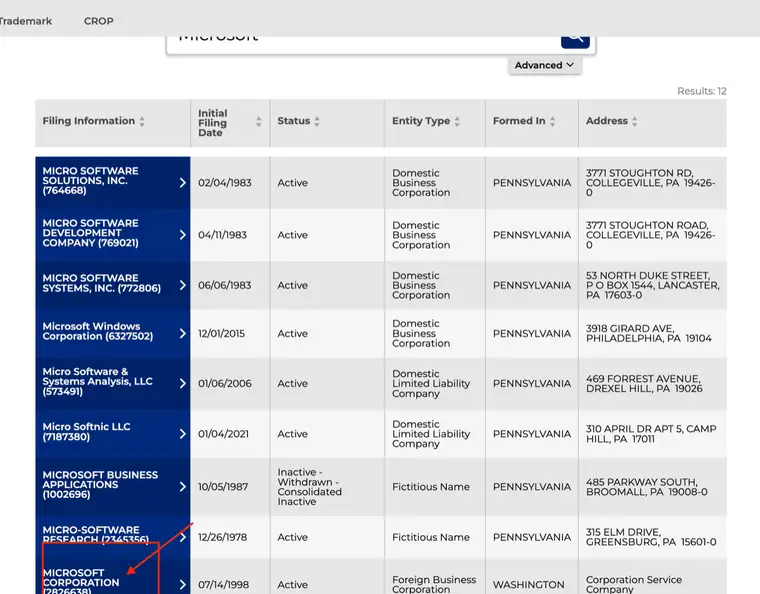
Every column here sorts, and two of them carry the answer. Entity Type mixes Domestic Business Corporation, Domestic Limited Liability Company, Foreign Business Corporation and Fictitious Name in one list, so a hit may be a registered trading name rather than a company. Status is more granular than most registers: alongside Active this capture carries Inactive - Withdrawn - Consolidated Inactive, a record explaining exactly how it ended. Formed In separates Pennsylvania companies from foreign ones registered here.
Step 4: Open the record for its county and its governors
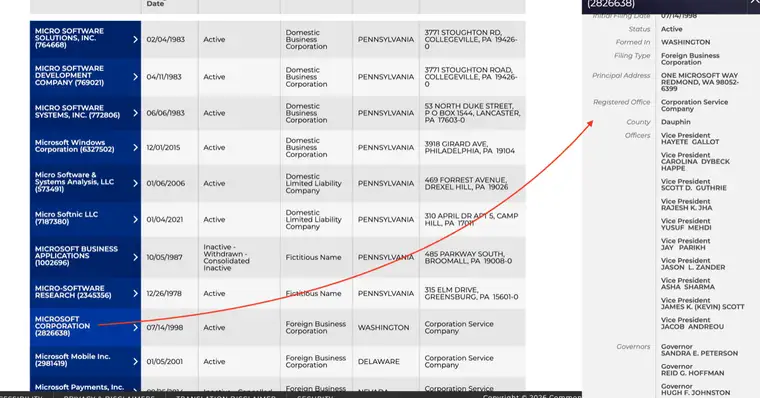
Clicking a row opens a drawer beside the results rather than a new page, so you can read a record without losing your list. Filing Type repeats the entity type, Formed In names the home jurisdiction, and County appears because Pennsylvania records where the registered office sits. The people are split into Officers and Governors, which is Pennsylvania’s statutory word for the people who direct an association, covering directors of a corporation and managers or members of an LLC alike.
Pennsylvania LLC naming rules
The rules are in 15 Pa.C.S. § 202 and § 204:
- Required ending: “company,” “limited” or “limited liability company,” or “co.,” “ltd.,” “L.L.C.” or “LLC,” or words of like import from another jurisdiction. “Company” alone is enough, which most states do not allow.
- The comparison set: the proper name of every other covered association on the Department’s records, plus names reserved or registered under §§ 208 to 210. A covered association means a domestic filing entity, a domestic limited liability partnership, an electing partnership or a registered foreign association.
- Designators are ignored in the comparison. Adding or dropping “Inc.” or “LLC” does not make two names distinguishable from each other.
- Three statutory releases, and none of them is dormancy. A blocking name opens up if the holder consents while stating it is about to change its name, cease business, wind up or withdraw; if the Department of Revenue certifies that it is out of existence or has failed for three successive years to file a required report or return; or if it abandoned the name in its home jurisdiction and certified proof is presented.
- One of the longest approval lists in the country. “Bank,” “trust company” and “savings bank” need banking authorization; “insurance,” “annuity,” “assurance,” “surety” and “title” need Insurance Department clearance; “engineer,” “architect” and “surveyor” need a licensed professional on record; “college,” “university” and “seminary” need State Board of Education approval; and “credit union,” “cooperative” and government references are restricted.
Reserving a name in Pennsylvania
A reservation is $70 on Form DSCB:15-208 and holds the name for 120 days.
That price is the outlier. Most states charge between $10 and $30 for the same 120 days, so Pennsylvania asks roughly three times the going rate, and the period cannot be renewed once it runs out. The same form transfers a reservation to another person, which is the only way a held name changes hands before it lapses. Given the cost, the reservation earns its place here in one situation in particular: when you are working through a consent or a Name Availability Certificate on a contested name and need the clear name held while that correspondence runs.
Fictitious names in Pennsylvania
Pennsylvania registers fictitious names centrally with the Department of State for $70 on Form DSCB:54-311, for companies and individuals alike. There has been no county filing since the early 1980s, when the Fictitious Names Act of 1982 replaced the older county-seat system.
Two rules shape what the filing is worth. The Department states plainly that registration creates no exclusive right: there are no ownership rights in a fictitious name, and another business may register exactly the same one. But the screen still runs on the way in. A fictitious name must be distinguishable from the names of associations registered with the Department, and removing a designator does not achieve that, so the Bureau will not let a registered company re-register its own name minus the “LLC.”
Publication is the other Pennsylvania quirk, and it is narrower than it looks. Under 54 Pa.C.S. § 311(g), advertising is required only when an individual is one of the parties listed on the form. An LLC registering in its own name has no publication step at all. Where it does apply, notice runs in two newspapers of general circulation in the county, one of which must be the legal newspaper, and the Bureau publishes a county-by-county list of which papers qualify.
If your Pennsylvania name is taken
- Check the processing date first. The search states how far behind it is. A very recent filing will not appear, and neither will yours for a few days after you file.
- Ask the holder for a Consent to Appropriation of Name. Form DSCB:19-17.2 is filed together with your own filing. This is the fastest route and the only one that does not depend on the Department’s judgment.
- If the holder cannot be reached, ask the Department. Email RA-CORPS@pa.gov with the subject line Name Availability, giving the exact name, the file number and the initial filing date. The reply comes in 7 to 10 days, either a Name Availability Certificate you upload with your filing or a refusal.
- A foreign company that abandoned the name at home can be cleared out. Certified proof from its home jurisdiction, presented to the Department, releases the name under § 202(b).
- Otherwise the answer may be 2028. If none of the three routes applies, the blocking record’s name is released only when administrative dissolution begins and it has not filed an annual report. That is a long wait, and it is usually the point at which changing the name is the cheaper decision.
If the search comes back clear, you can start your Pennsylvania LLC with that name. The Certificate of Organization is $125, and there is an ongoing obligation that is new: the annual report that replaced the decennial filing costs $7 and falls due by September 30 each year. It is a small amount attached to a large consequence, since missing it is what will eventually put a company into the administrative dissolution the whole naming picture above turns on.
Official Pennsylvania sources
- Department of State business search: entities and fictitious names, with the processing date on the page
- Name Availability: the Act 122 transition, the three release routes and how to request a Name Availability Certificate
- 15 Pa.C.S. § 202: duplicate use of names and the covered association comparison set
- 15 Pa.C.S. § 204: the designator, including “Company” and “Limited” alone
- Fictitious Names: the $70 central registration, the no-exclusive-right rule and the advertising requirement
Frequently asked questions
How do I check business name availability in Pennsylvania?
Search the Department of State's business filing search. It has one box that takes either a name or a file number. Before you read the results, read the line under the heading: the page prints the date through which filings have been processed, so a company registered in the last few days may not be in the index yet.
A Pennsylvania company with my name has not filed anything in decades. Can I take the name?
Not on that basis alone, and this is where Pennsylvania differs from most states right now. Act 122 of 2022 repealed the decennial report route on January 3, 2023, and administrative dissolution does not start until 2028, so a dormant record that never formally dissolved keeps blocking its name. The Department of State estimates hundreds of thousands of records are in that position.
What is a Name Availability Certificate?
It is the Department of State's written finding that a name held by an older record can be used. If you cannot reach the prior filer for a Consent to Appropriation of Name, email RA-CORPS@pa.gov with the subject line Name Availability, giving the exact name, the file number and the initial filing date. The Department replies in 7 to 10 days, and if the answer is yes you upload the certificate with your filing.
How much does it cost to reserve a business name in Pennsylvania?
The reservation is $70, which is among the highest in the country against the $10 to $30 most states charge, and it holds the name for 120 days. The period cannot be renewed, although the same form transfers the reservation to someone else.
Do Pennsylvania fictitious names appear in the business search?
Yes, and the results label them Fictitious Name in the Entity Type column. Registration grants no exclusive right, so two businesses may hold the same fictitious name, and finding one does not stop you registering it too. It works in the other direction though: a fictitious name has to be distinguishable from registered entity names on the way in, and dropping a designator such as Inc. or LLC does not make it distinguishable.