
South Carolina Business Name Availability Checker
Data verified July 17, 2026 · Official database: South Carolina Secretary of State
LLC filing fee
Name reservation cost
Reservation hold non-renewable
Quick answer: South Carolina names are checked in Business Entities Online, where the match dropdown opens on Begins With rather than a contains search, so a narrow query can miss a real conflict. S.C. Code § 33-44-105 asks for an LLC designator and a name distinguishable upon the state’s records. One thing to know before you read the results: South Carolina runs no statewide DBA, so trade names are registered city by city and never appear here. The Business Filings Division makes the call when your filing reaches it.
How to check a name in South Carolina
The checker above queries South Carolina records for you. The four steps below walk the same Business Entities Online screens, so you can run the search at the source and compare what comes back. Nothing on those screens is a decision, though. South Carolina fixes availability only when the Business Filings Division processes the filing in front of it.
Step 1: Open the Business Name Search
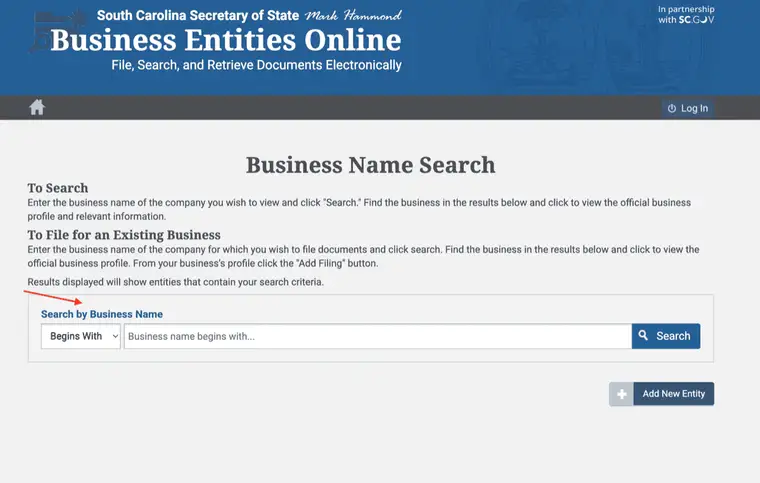
Open Business Entities Online, the Secretary of State’s system to “File, Search, and Retrieve Documents Electronically.”
Under Search by Business Name, a match dropdown defaults to Begins With, beside a Business name begins with… field and a Search button. The page notes that “results displayed will show entities that contain your search criteria.” Leave the Add New Entity button alone unless you are filing a new company.
Step 2: Enter your proposed name without LLC
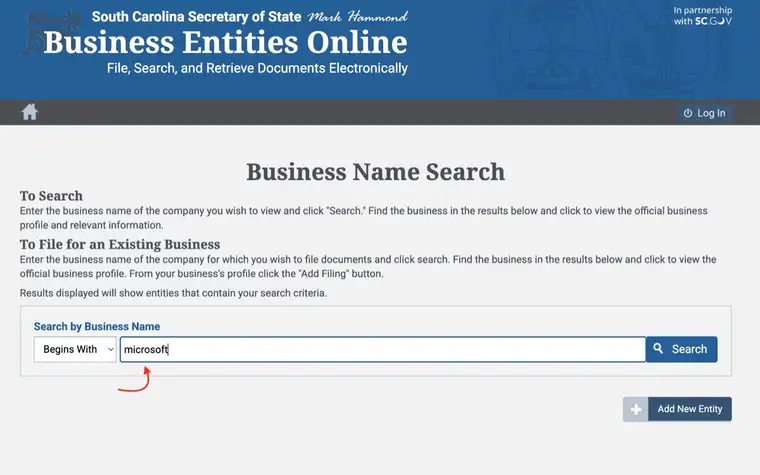
Type the distinctive words of your name into the search field and leave off the ending (LLC, L.L.C.). With Begins With selected, South Carolina returns entities whose names start with what you type, so search the leading words of your name rather than the whole legal name.
Widen the match with the dropdown if the leading words are common, then press Search.
Step 3: Read the Search Results table
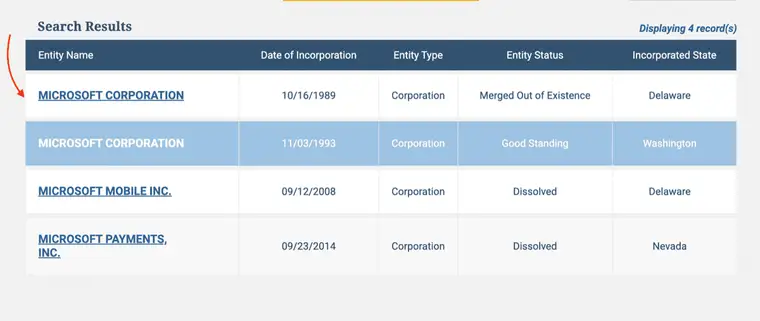
South Carolina opens a Search Results table and reports the count (“Displaying 4 record(s)”). Its columns are Entity Name, Date of Incorporation, Entity Type, Entity Status, and Incorporated State.
Read the Entity Status column closely. Values such as Good Standing, Dissolved, and Merged Out of Existence each mean something different for whether a name is free: a good-standing entity is a live conflict, while a dissolved one may eventually release its name. Open a record by clicking its Entity Name.
Step 4: Open the entity's profile
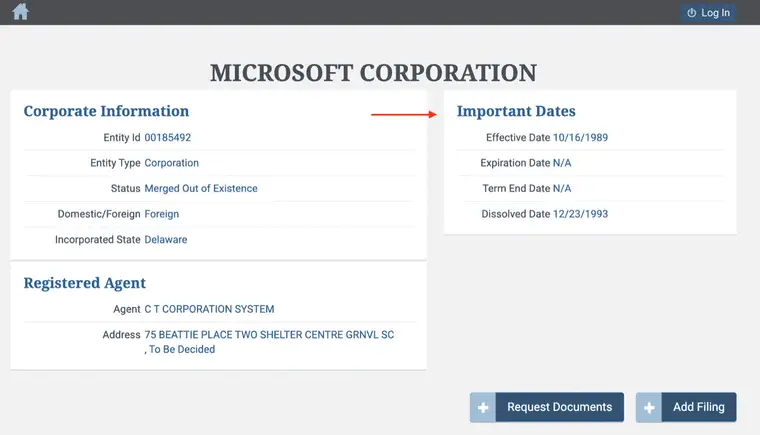
The profile groups fields under Corporate Information (Entity Id, Entity Type, Status, Domestic/Foreign, Incorporated State), Important Dates (Effective, Expiration, Term End, Dissolved), and Registered Agent.
Confirm the status and home state before treating a hit as a conflict. A foreign corporation marked Merged Out of Existence is a very different signal from an in-state LLC in Good Standing. If nothing matches your wording or its close variations, you have a good preliminary reading. Convert it into a reservation or a filing before you build anything on it, because a search result holds no part of the name for you.
South Carolina LLC naming rules
South Carolina’s LLC name rules come from the state’s Uniform Limited Liability Company Act, S.C. Code § 33-44-105:
- Required ending: “limited liability company,” “limited company,” or an abbreviation such as LLC, L.L.C., L.C., or LC. “Limited” may be shortened to “Ltd.” and “company” to “Co.”
- Distinguishability: the name must be distinguishable upon the state’s records from every registered entity and every reserved or registered name.
- No borrowed identity: the name may not use words that imply it is a different kind of entity than the one you are forming.
Words that need approval in South Carolina
The LLC statute itself asks only for the designator and distinguishability. The restricted terms below come from South Carolina’s separate licensing laws, so a name that uses one is accepted only if the business is licensed for that activity.
| Term family | Examples | Where the restriction comes from |
|---|---|---|
| Banking | bank, banking, trust, savings and loan | S.C. Code Title 34, banks and financial institutions |
| Insurance | insurance, assurance | S.C. Code Title 38, insurance |
Professional-practice terms, such as “engineering” or “architecture,” are limited separately under the licensing boards in Title 40.
Reserving a name in South Carolina
If you are not ready to file Articles of Organization, South Carolina lets you hold a name for 120 days for $25 through the Secretary of State’s business entities service. The hold is nonrenewable, so if it lapses before you file, the name returns to the open pool.
Forming the LLC itself costs $110. After that, South Carolina is lighter than most states on upkeep: its LLCs owe no annual report to the Secretary of State, so once you have filed, the reservation is one of the few name-related filings the office handles for an LLC.
Doing business under another name in South Carolina
South Carolina is one of the few states with no statewide DBA. It runs no assumed-name or fictitious-name registration for LLCs, corporations, or sole proprietors at the state level. A business that trades under a name other than its legal name registers that name locally, usually when it applies for a city or county business license, not with the Secretary of State.
Two narrow exceptions do reach the state: a limited partnership operating under a different name, and a foreign entity whose legal name is not available in South Carolina, both register an assumed name with the Secretary of State. How assumed and trade names work in states that do register them varies widely from one state line to the next.
If your South Carolina name is taken
A conflict in Business Entities Online does not end the naming process:
- Add a genuinely distinguishing element. Swapping LLC for L.C., or moving punctuation around, leaves you in the same place on the state’s records. What moves you is a word that means something.
- Check the entity’s status. A name held by a dissolved or merged entity may free up once the state resolves the record, so a marginal conflict can be worth monitoring rather than abandoning.
- Reserve as soon as it is clear. Because South Carolina reservations cannot be renewed, reserve close to when you plan to file so the 120-day hold covers the wait rather than expiring before it.
Because the 120-day hold cannot be restarted, reserving too early can leave you filing after it has already lapsed. If your search is clear, the simpler route is to start your South Carolina LLC under that name and let the filing itself claim it.
Official South Carolina sources
- Business Entities Online search: the authoritative database
- S.C. Code Title 33, Chapter 44: the LLC naming and reservation statute
- Secretary of State business entities: filing and reservation
- Business entity FAQs: common filing questions
Frequently asked questions
How do I check LLC name availability in South Carolina?
Search the South Carolina Secretary of State's Business Entities Online system for your proposed name and its close variations. If no active entity or reservation matches, the name is likely open. The office makes the final call when it processes your Articles of Organization or reservation.
Does a South Carolina LLC name have to include "LLC"?
Yes. The name must contain "limited liability company," "limited company," or an abbreviation such as LLC, L.L.C., L.C., or LC. "Limited" may be shortened to "Ltd." and "company" to "Co."
How much does it cost to reserve a business name in South Carolina?
A reservation is $25 and holds the name for 120 days. The hold is nonrenewable, so if it lapses before you file, the name returns to the open pool and anyone, including you, may reserve or file it again.
Does South Carolina require a DBA filing?
No. South Carolina has no statewide DBA or assumed-name registration for LLCs, corporations, or sole proprietors. A business that trades under another name registers it locally when it gets a city or county business license. Only limited partnerships and foreign entities whose legal name is unavailable file an assumed name with the Secretary of State.
Do South Carolina LLCs file an annual report?
Not with the Secretary of State. Unlike most states, South Carolina LLCs owe no annual report to the Secretary of State. Business corporations file an annual report with the Department of Revenue instead.