
Tennessee Business Name Availability Checker
Data verified July 25, 2026 · Official database: Tennessee Secretary of State
LLC filing fee
Name reservation cost
Reservation hold
Quick answer: Tennessee tells you how current its own records are before you type anything. A green line above the search box on the Secretary of State’s Business Entity Search gives the date through which filings have been processed, and on the day these screens were captured that date was two days old. A name filed inside that window can be missing from a result that looks clear. The state names the consequence from the other end too, listing a name that is “not distinguishable from another business entity on file” among the most common reasons a filing gets rejected.
How to check a name in Tennessee
The checker above is the fast first pass. The four screens below follow the Secretary of State’s Business Entity Search, which runs on the TNCaB portal and holds every Tennessee entity record. The form is plain, and the results grid does something most state portals do not: it prints a company’s other names in a column of their own. What you find is preliminary. The Secretary of State decides the name when your Articles of Organization are reviewed.
Step 1: Open the Business Entity Search and read the date
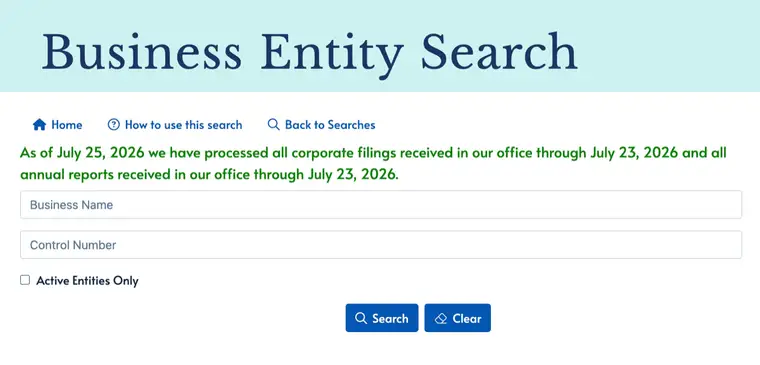
Open the Business Entity Search and start with the green sentence, not the form: “As of July 25, 2026 we have processed all corporate filings received in our office through July 23, 2026 and all annual reports received in our office through July 23, 2026.” That line moves with the office’s backlog and dates everything below it. The form itself is two fields, Business Name and Control Number, with an Active Entities Only checkbox and Search and Clear buttons.
Step 2: Enter the distinctive words only
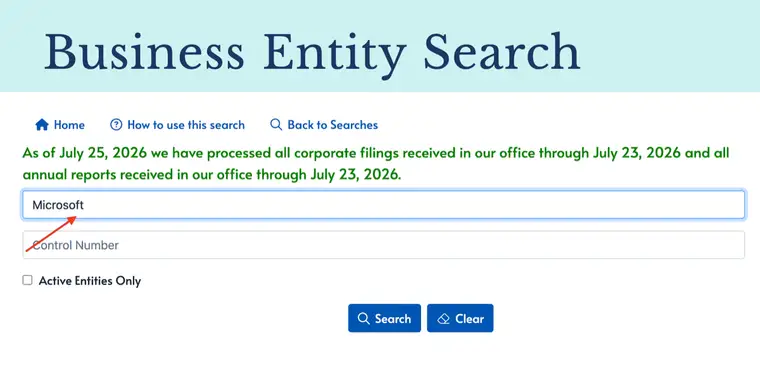
Type the distinctive part of your name into Business Name and stop there. Leaving off “LLC” is not just tidier: entity endings do no work in the comparison, and § 48-249-106 bars “corporation” and “incorporated” from an LLC name anyway. Leave Active Entities Only unchecked, the way the form arrives, so dissolved and withdrawn records stay in view. Tennessee lets an administratively dissolved company apply for reinstatement on form SS-9410, so a name attached to an inactive record is not free ground.
Step 3: Read the Other Names Used column
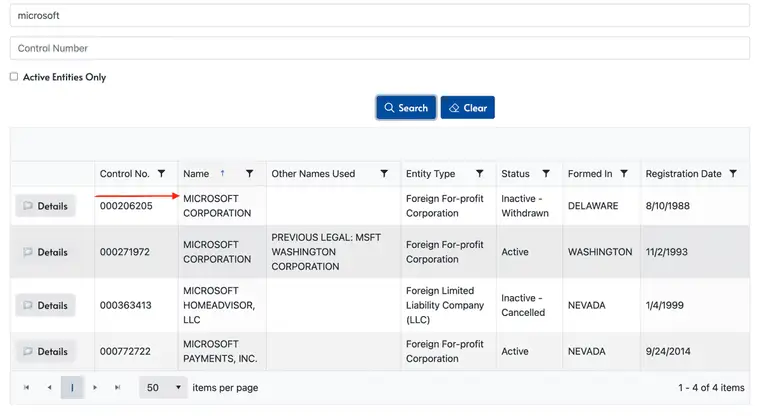
The grid carries Control No., Name, Other Names Used, Entity Type, Status, Formed In and Registration Date, each with its own filter control, and a Details button on every row. Other Names Used is the column to slow down on: one row here reads “PREVIOUS LEGAL: MSFT WASHINGTON CORPORATION” beside a current name of MICROSOFT CORPORATION, history that most portals bury behind a tab on the record screen. Read Status in full as well, since Tennessee writes it in two parts, so Inactive - Withdrawn and Inactive - Cancelled sit next to plain Active.
Step 4: Open Details and check all four standings
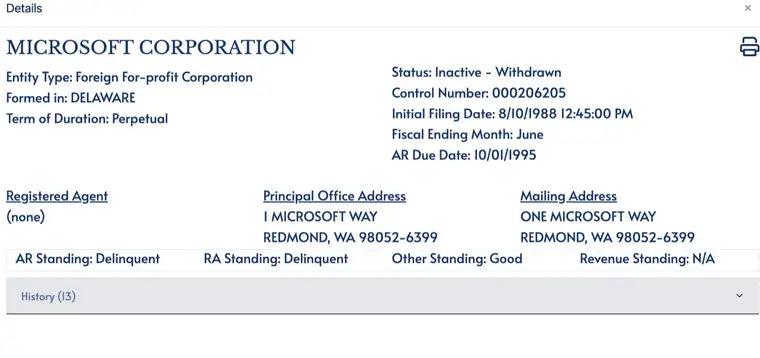
Details opens over the results rather than on a page of its own, with Entity Type, Formed in, Term of Duration, Status, Control Number, Initial Filing Date and AR Due Date above registered agent and address blocks. Under those, Tennessee splits standing four ways: AR Standing, RA Standing, Other Standing and Revenue Standing, so one record can be delinquent on its annual report and its registered agent while its other standing still reads Good. At the foot, History expands the filing trail, which is where a name change carries its date.
Tennessee LLC naming rules
The rules sit in Tenn. Code Ann. § 48-249-106:
- Required ending: the words “limited liability company,” the abbreviation “L.L.C.” or “LLC,” or words of like import in another language, written in roman characters.
- Two words are barred outright: an LLC name may not contain “corporation” or “incorporated,” or an abbreviation of either.
- Distinguishable upon the records: the name must be distinguishable from the name of, or for, every other entity on the Secretary of State’s records, whether that name is true, assumed, reserved or registered.
- Restricted words are defined by function, not by list: Tennessee bars language implying that the company transacts a business needing state authorization, such as banking, insurance or trust powers, unless the appropriate official certifies that authorization in writing to the Secretary of State. The same subsection covers implied affiliation with fraternal, veterans’, religious or charitable organizations and with agencies of the United States government.
- Three routes past a conflict, and the third is unusual: written consent from the other holder together with its undertaking to cancel or change its own name; a certified copy of a final court judgment establishing your right; or written consent where both companies agree to use the same registered agent.
Reserving a name in Tennessee
A reservation costs $20 on form SS-9425 and holds the name for four months, mid-range in length and cheap for it: Georgia holds a name 30 days for $35, Washington 180 days for $30.
What is different here is the ending. § 48-249-107 provides no renewal. When the four months run out, “the same party, or any other party, may apply to reserve the same name,” so nothing stops you applying again and nothing stops someone else taking it the day it lapses. Transferring a reservation is a separate $20 notice on form SS-4406.
Assumed names in Tennessee
Tennessee’s DBA is an entity filing rather than a personal one. An LLC or corporation registers an assumed name with the Secretary of State on form SS-4402 for $20, and it runs five years before renewal on SS-4481 for another $20. There is no publication step and no statewide register for sole proprietors, so an individual trading under a business name here may leave no state record at all.
The registration grants no trademark right, but it is not decorative. Because § 48-249-106 measures new names against assumed names as well as true ones, a live assumed name blocks a later name that is not distinguishable from it. That is why the search grid prints them beside current names.
If your Tennessee name is taken
- Changing the ending will not help. “Corporation” and “incorporated” are barred from an LLC name, so the swap that works in some states is unavailable here.
- A consent letter on its own does not clear the conflict. The other holder must also undertake to cancel or change its own name, filed as a Written Consent for Use of Indistinguishable Name, form SS-9411, $20.
- The shared registered agent route is worth knowing. Two companies may hold names that are not distinguishable if both consent and both use the same registered agent, which fits sister companies under common ownership and exists in very few other states.
- Inactive does not mean free. A dissolved or revoked Tennessee company can apply for reinstatement, so read the withdrawn and cancelled rows rather than filtering them out.
- Open Other Names Used before you rule a name in. The conflict may be a previous legal name on a company trading under something else entirely.
If the record looks clear, you can start your Tennessee LLC with that name. Budget for the way Tennessee prices an LLC by its membership rather than its name: Articles of Organization start at $300, and the annual report is $300 minimum, rising $50 for every member above six, to a $3,000 maximum. The number of members you file with sets the recurring bill.
Official Tennessee sources
- Business Entity Search: the Secretary of State’s entity records on TNCaB
- Tenn. Code Ann. § 48-249-106: required and barred words, the distinguishability test and its three exceptions
- Tenn. Code Ann. § 48-249-107: the four-month reservation and its transfer
- Business forms and fees: SS-9425 $20, SS-4270 $300, SS-4402 $20, SS-9411 $20
- Business services FAQs: the per-member annual report fee and the most common reasons a filing is rejected
- Tennessee Code Unannotated: the official code, as linked by the Secretary of State
Frequently asked questions
How do I check business name availability in Tennessee?
Search the Secretary of State's Business Entity Search on the TNCaB portal, entering the distinctive words in the Business Name field and leaving out "LLC." Read the green processing notice at the top of the form first, because it states the date through which filings have been processed, and anything filed after that date is not in the answer you are reading. Leave the Active Entities Only box unchecked so dissolved and withdrawn records stay in view.
What does the Other Names Used column mean in Tennessee search results?
It holds names a record has carried besides its current one, including previous legal names and registered assumed names. One row in a search for Microsoft reads "PREVIOUS LEGAL: MSFT WASHINGTON CORPORATION" beside a current name of MICROSOFT CORPORATION. Tennessee screens a new name against assumed and former names as well as live ones, so this column can hold the conflict that stops your filing.
How much does it cost to reserve a business name in Tennessee?
A reservation is $20 on form SS-9425 and holds the name for four months. There is no renewal step. Tenn. Code Ann. § 48-249-107 says that once the four months expire, the same party or any other party may apply for the same name, so you can apply again and so can anyone else. Transferring a reservation costs another $20 on form SS-4406.
Does registering an assumed name protect it in Tennessee?
It grants no trademark right, but it does real work in the record. An assumed name is registered by an entity with the Secretary of State for $20 and lasts five years. Because § 48-249-106 measures new names against assumed names as well as true names, a live assumed name blocks a later name that is not distinguishable from it. Sole proprietors have no statewide registry to file in at all.
Why does a Tennessee search return companies formed in other states?
The Formed In column shows where each record was organised, and foreign companies registered to transact business in Tennessee sit in the same records as domestic ones. A Delaware corporation or a Nevada LLC with a Tennessee registration is measured against your proposed name exactly like a Tennessee entity, so a row that says NEVADA is not a row you can skip.