
Texas Business Name Availability Checker
Data verified July 11, 2026 · Official database: Texas Comptroller of Public Accounts
LLC filing fee
Name reservation cost
Reservation hold renewable
Quick answer: Texas offers a free screening tool, the Comptroller’s Taxable Entity Search, while the Secretary of State makes the binding availability decision when you file. An LLC name needs a valid ending under BOC § 5.056 and must be distinguishable from every existing filing, reservation, and registered series under § 5.053.
Which Texas portal answers which question
Texas is the only pilot state that splits name checking across two agencies, and the split is the most common source of confusion here. The Comptroller of Public Accounts publishes the free database nearly everyone screens against. The Secretary of State is the office that actually decides your name. Searches for “Texas CPA business search” usually mean the Comptroller of Public Accounts, not the accounting credential.
| Comptroller Taxable Entity Search | Secretary of State | |
|---|---|---|
| What it answers | Is this wording already used by a taxable entity? | Will this name be accepted on a filing? |
| Cost | Free | $1 per preliminary search on SOSDirect |
| Weight | Screening signal only | Binding, at the moment of filing |
| Holds records of | Franchise tax accounts, taxpayer numbers, SOS registration status | Filing entities, foreign registrations, reserved names, registered series |
| Use it to | Narrow a shortlist at no cost | Reserve with Form 501, or form the LLC |
The two indexes are not the same list, and that is the part worth understanding. A clean Comptroller result means no taxable entity carries your wording. It does not mean the Secretary of State will accept the name. A name that someone reserved but has not yet formed never opened a franchise tax account, so it can be absent from the Comptroller’s records while still blocking you under § 5.053. Registered series sit in Secretary of State records for the same reason.
How to run a Texas name search
The four steps below walk the free Comptroller portal, which is where a Texas search normally starts. Treat a clean result as a strong screening signal, not a guarantee. The Secretary of State’s SOSDirect preliminary search (about $1 per lookup) sits closer to the filing office’s own index and is still labeled preliminary. Neither tool is final approval.
Step 1: Open the Comptroller Franchise Tax search
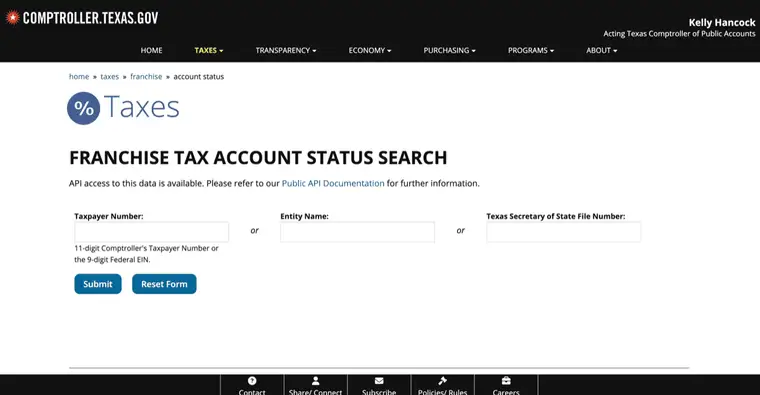
Open the free Comptroller Taxable Entity Search. The page title is FRANCHISE TAX ACCOUNT STATUS SEARCH on comptroller.texas.gov.
You can search by Taxpayer Number, Entity Name, or Texas Secretary of State File Number. For a proposed business name, use Entity Name. The Taxpayer Number helper text accepts an 11-digit Comptroller number or a 9-digit federal EIN when you already have one.
Buttons under the fields are Submit and Reset Form.
Step 2: Enter the core name in Entity Name
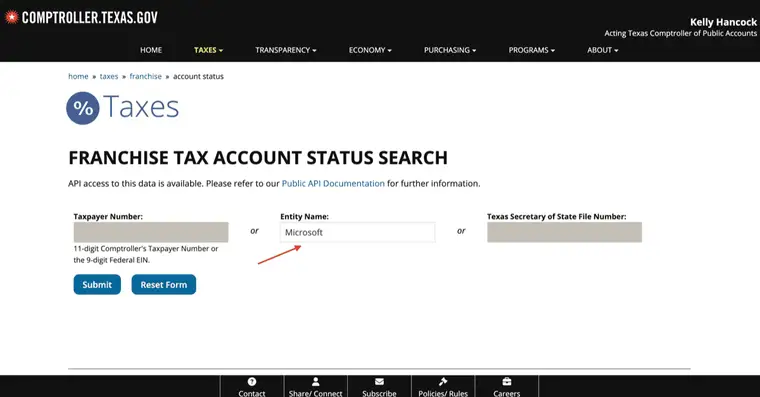
Type the distinctive words of your proposed name into Entity Name. Leave off LLC, L.L.C., and similar endings so the list catches every entity type using those words.
When Entity Name is active, the other two fields gray out. Press Submit (or Reset Form to clear). This path stays on the free Comptroller site; it is not the paid SOSDirect name product.
Step 3: Scan the results table
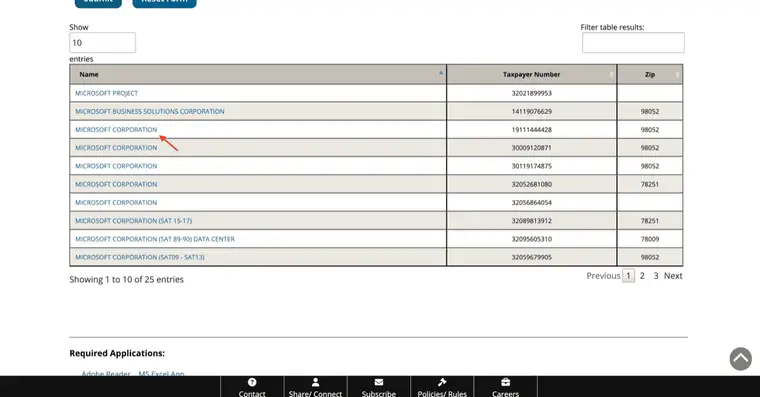
Matching entities appear in a table with Name, Taxpayer Number, and Zip. You can change how many rows show, use Filter table results, and page through entries when the list is long.
Open a row by clicking the blue name link. Multiple rows can share similar wording with different taxpayer numbers. Treat every close hit as a potential conflict until you confirm distinguishability under § 5.053.
Step 4: Read the entity detail record
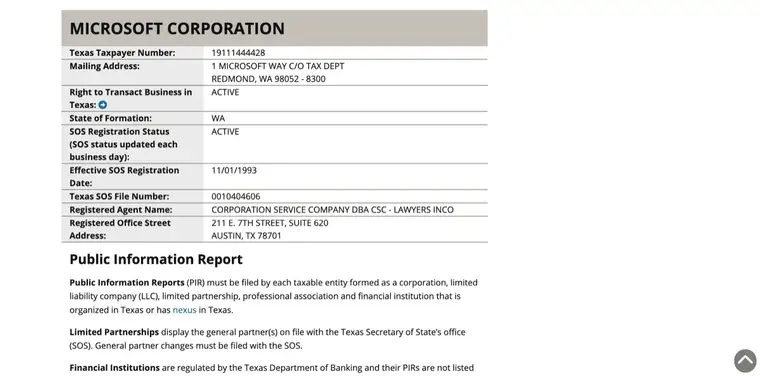
The detail card shows Texas Taxpayer Number, mailing address, Right to Transact Business in Texas, State of Formation, SOS Registration Status, effective SOS registration date, Texas SOS File Number, registered agent, and registered office street address.
For name research, SOS Registration Status and Right to Transact Business in Texas (for example ACTIVE) tell you the record is live on state systems. The Public Information Report section explains filing duties for taxable entities; it is background, not a name approval.
If no close matches appear for your wording and variations, that is only a preliminary Comptroller signal. File or reserve with the Secretary of State before relying on the name.
Texas LLC naming rules
Chapter 5 of the Business Organizations Code governs Texas names:
- Ending requirement (§ 5.056): the name must carry “limited liability company,” “limited company,” or an abbreviation like “LLC,” “L.L.C.,” “LC,” or “L.C.”
- Distinguishability (§ 5.053): your name is measured against existing filing entities, foreign registrations and their fictitious names, reserved and registered names, and registered series of Texas LLCs (a category no other pilot state checks).
- No false government ties (§ 5.064): anything implying affiliation with a state or federal body is refused.
Restricted and prohibited terms
| Term | Status | Authority |
|---|---|---|
| lotto, lottery | Prohibited entirely | BOC § 5.061 |
| veteran, legion, foreign, Spanish, disabled, war, world war | Allowed only with written approval from a congressionally recognized veterans organization | BOC § 5.062 |
Holding a name with a Texas reservation
Texas reservations run longer than most states’ and can be renewed. Filing Form 501 with the Secretary of State costs $40 (BOC § 4.151(2)) and locks the name for 120 days. During the final 30 days of that window you may renew for another 120 days (§§ 5.104–5.105), and there is no limit on renewals, so a name can be held indefinitely at $40 per cycle. The Secretary of State’s name filings FAQ covers the mechanics. See how that compares with other states on business name reservation by state.
When you are ready to form, the certificate of formation (Form 205) carries a $300 filing fee. Texas has no annual report fee for LLCs; instead, entities file an annual franchise tax report with the Comptroller by May 15.
Assumed names in Texas
Since 2019, an LLC files its assumed name certificate only with the Secretary of State: Form 503, $25, good for up to ten years. Sole proprietors and partnerships still file with each county where they do business. The certificate grants nothing in the name itself; § 71.157 says filing is not use for priority. The state copy is searchable only through SOSDirect at $1 per look, and trading under an unregistered assumed name bars a business from maintaining a lawsuit in Texas courts.
When the name you want is in use
Options if the Taxable Entity Search turns up a conflict:
- Rework the distinctive words. Because § 5.053 ignores differences in suffixes and minor punctuation, plan on changing at least one substantive word.
- Look into consent. Texas allows some otherwise-conflicting names to proceed with the existing entity’s notarized written consent. Ask the Secretary of State whether your specific conflict qualifies.
- Separate the brand from the entity. Registering an assumed name (DBA) lets a Texas LLC trade under a different name than the one on its certificate of formation.
Once a name comes back clean, the way to secure it permanently is to form your Texas LLC under that name. A reservation holds the name; only a formation makes it yours.
Official Texas sources
- Comptroller Taxable Entity Search: the free public database
- Tex. Bus. Orgs. Code ch. 5: the naming statute
- Tex. Bus. Orgs. Code § 4.151: filing fees
- Secretary of State name filings FAQ: reservations and consents
Frequently asked questions
Is there a free way to search Texas business names?
Yes. The Texas Comptroller's Taxable Entity Search is free and covers entities registered with the state. The Secretary of State's own SOSDirect preliminary name search costs $1 per search, and only the Secretary of State's review at filing time is binding.
Why does Texas name checking involve two different agencies?
Formation filings and name decisions belong to the Texas Secretary of State, but the Comptroller of Public Accounts publishes the free public database of taxable entities. Most founders screen against the Comptroller's records first, then rely on the Secretary of State for the official determination.
Can a Texas name reservation be renewed?
Yes. A reservation (Form 501, $40) holds the name for 120 days, and you may renew it for successive 120-day periods by filing again during the 30 days before it expires. That allows a name to be held indefinitely at $40 per cycle.
What words are off-limits in a Texas LLC name?
"Lotto" and "lottery" are prohibited outright. Veteran-related terms (veteran, legion, foreign, Spanish, disabled, war, world war) require written approval from a congressionally recognized veterans organization, and no name may falsely imply a government affiliation.