
Utah Business Name Availability Checker
Data verified July 26, 2026 · Official database: Utah Division of Corporations and Commercial Code
LLC filing fee
Name reservation cost
Reservation hold
Quick answer: Utah weighs a new name against more records than a company register holds. § 48-3a-108 requires it to be distinguishable on the Division of Corporations’ records from entity names, reserved names, assumed names and any tradename, trademark or service mark registered with the Division. The Business Search prints its own scope above the form: “Includes Business Entities, Name Reservations & Foreign Name Registrations.” So the thing that blocks your filing may be a DBA or a registered mark rather than a company, and it will be sitting in the same results list.
How to check a name in Utah
The checker above is the fast first pass. The four screens below follow the Division of Corporations and Commercial Code’s Business Search. It is the most configurable portal in this guide, which cuts both ways: three match modes and a field for assumed names, but it opens on the setting most likely to hide your conflict. What you find is preliminary. The Division decides the name when your Certificate of Organization is reviewed.
Step 1: Open the Business Search and read its scope line
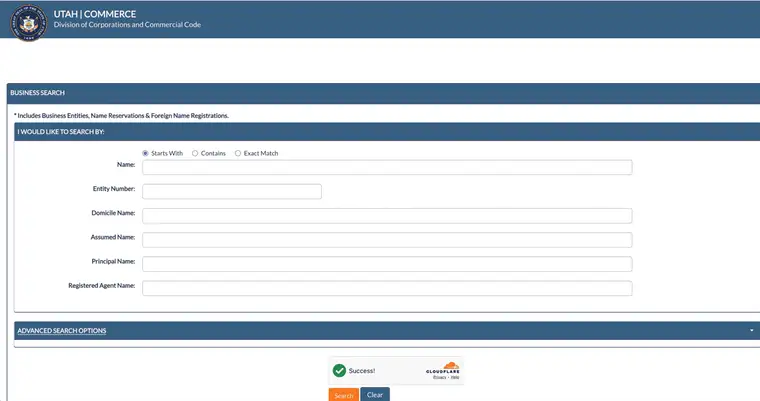
Open the Business Search. Directly under the BUSINESS SEARCH heading the page states what it covers: “Includes Business Entities, Name Reservations & Foreign Name Registrations.” Below that, I WOULD LIKE TO SEARCH BY offers Starts With, Contains and Exact Match, then six fields: Name, Entity Number, Domicile Name, Assumed Name, Principal Name and Registered Agent Name. Assumed Name having its own box is the tell that Utah keeps DBAs in these records.
Step 2: Run it on Starts With, then run it again on Contains
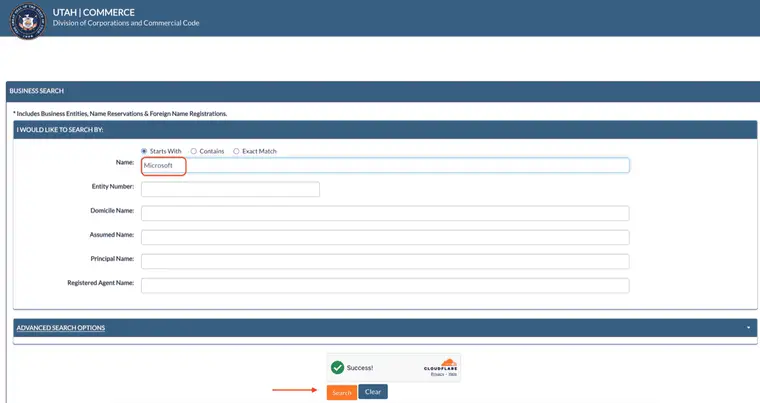
Type the distinctive words into Name without “LLC”, since § 48-3a-108 disregards entity-type words when it compares names. The capture shows the form as it arrives, on Starts With, which only finds records that open with your words. Search once that way, then select Contains and search again: that is the pass that surfaces a conflict buried in the middle of a longer name. Keep Exact Match for confirming one specific record.
Step 3: Read Status and Status Details together, and look at the Type column
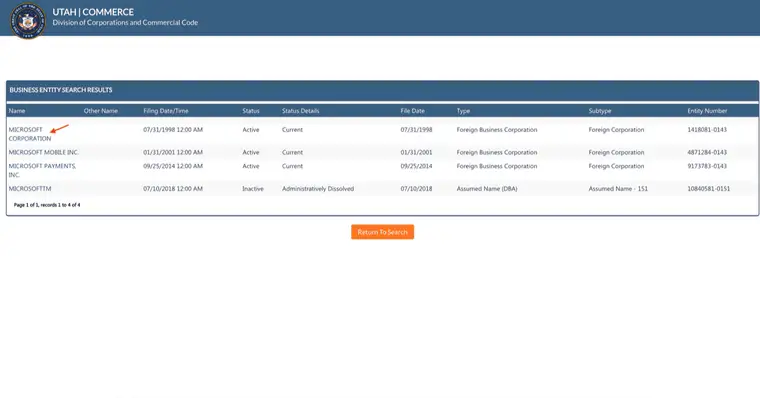
The results carry Name, Other Name, Filing Date/Time, Status, Status Details, File Date, Type, Subtype and Entity Number. Two columns do the work of one elsewhere: Status says Active or Inactive, and Status Details says why, so a row reads Inactive and Administratively Dissolved together. Read Type on every row. The fourth result here is MICROSOFTTM, whose type is Assumed Name (DBA) and whose subtype is Assumed Name - 151, sitting in the same list as three corporations. The entity number ends in the same code as the subtype, 0151 for that row against 0143 for the foreign corporations.
Step 4: Open the record for its renewal date
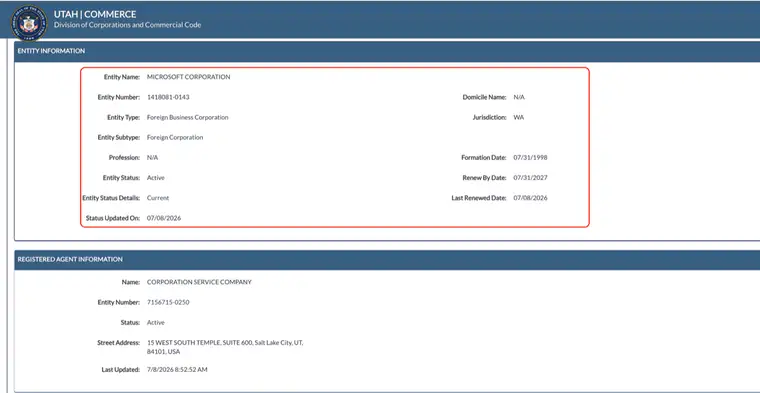
ENTITY INFORMATION repeats the status pair and adds Entity Type, Entity Subtype, Profession, Domicile Name, Jurisdiction and Formation Date, then two dates that show how current the record is: Last Renewed Date and Renew By Date. Utah renewals run annually, and Status Updated On dates the status itself. Domicile Name fills in when a foreign company trades here under a different name from its home one. The REGISTERED AGENT INFORMATION block below carries the agent’s own entity number as a link.
Utah LLC naming rules
The rules are in Utah Code § 48-3a-108:
- Required ending: “limited liability company” or “limited company,” or the abbreviation “L.L.C.,” “LLC,” “L.C.” or “LC.” “Limited” may be shortened to “Ltd.” and “company” to “Co.”
- Barred terms: an LLC name may not contain “association,” “corporation,” “incorporated,” “partnership,” “limited partnership” or “L.P.”
- A wider comparison than most states run: the name must be distinguishable on the Division’s records from the actual, reserved and assumed names of registered entities and from any tradename, trademark or service mark registered with the Division.
- The test, and what fails it: a name is distinguishable if it “contains one or more different words, letters, or numerals.” Entity-type words, the articles “the,” “and” and “a,” punctuation, capitalization and singular versus plural forms are all disregarded, so “Alta Roofing” and “Alta Roofings, LLC” are the same name here.
- Words that need someone else’s written consent first: the bank family (Bank, Banker, Banking, Banc, Banque, Banco, Bancorp, Bancorporation, Bankcard, Bancard, Savings Association, Building Association, Savings and Loan Assoc.) from the Department of Financial Institutions; “university,” “college” and “institute” from the Division of Consumer Protection under § 53B-5-114; and “Olympic,” “Olympiad” and “Citius Altius Fortius” from the United States Olympic Committee.
- A flat ban with a date on it: an LLC formed or renamed on or after May 4, 2022 may not use the number sequence 911.
- Two routes past a conflict: the other holder consents in writing and undertakes to change its own name, or you deliver a certified court judgment establishing your right to the name.
One housekeeping note for anyone citing the law later: Utah renumbers this chapter to Title 16, Chapter 20 on October 1, 2026, so the section numbers above move even though the requirements do not.
Reserving a name in Utah
A reservation costs $22 and holds the name for 120 days, and it can be transferred to someone else by signed notice.
Utah is one of the few states where reserving deserves a second thought, because forming is so cheap. The Certificate of Organization is $59, so a reservation costs a bit over a third of the real thing and buys four months, while filing buys the name outright and starts an annual renewal cycle at $18. Where formation runs into the hundreds a hold is obvious value. Here it is a closer call.
DBAs in Utah
Utah runs a clean state-level DBA. One registration with the same Division costs $22, covers the whole state, and runs three years rather than the annual cycle most Utah filings follow. There is no county filing and no newspaper publication, and a sole proprietor pays the same $22 an LLC does.
Two limits matter. A DBA cannot be amended, so a name change means a fresh filing, and an expired registration cannot be reinstated. The Division is also explicit that registering a name does not authorize using it against someone else’s rights. What it does do is join the records the Division screens, which is why a DBA row turned up in the results above and why an active one can block your name.
If your Utah name is taken
- The differences that feel meaningful usually are not. Articles, punctuation, capitalization and adding an “s” are all disregarded, so a plural of a taken name is the taken name.
- Changing the ending is not an option here. “Corporation,” “incorporated,” “association,” “partnership” and “L.P.” may not appear in an LLC name at all.
- Check whether the blocker is a company. Utah screens registered tradenames, trademarks and service marks too, and a mark holder is a different negotiation from a dormant company.
- Consent alone will not do it. The other holder has to consent in writing and undertake to change its own name, or you need a certified court judgment.
- If a DBA is in the way, look at its dates. Utah DBAs run three years and cannot be reinstated once they lapse, so the record blocking you may have a visible end date.
If the search comes back clear, you can start your Utah LLC with that name. Utah is at the cheap end of the country for this: $59 to file the Certificate of Organization and $18 a year to renew, against a $22 hold that expires.
Official Utah sources
- Business Search: the Division of Corporations and Commercial Code’s records
- Utah Code § 48-3a-108: permitted names, the distinguishability test and the barred terms
- Utah Code § 48-3a-109: the 120-day reservation and its transfer
- Business name conventions and policies: the restricted words and which agency must consent to each
- DBA registration: the $22 three-year assumed name
- Fee schedule: the $59 Certificate of Organization, $22 reservation and $18 renewal
Frequently asked questions
How do I check business name availability in Utah?
Search the Division of Corporations and Commercial Code's Business Search, entering your words in the Name field. The form opens on Starts With, so run the search again with Contains before you decide, since that is the setting that finds your words inside a longer name. The search covers business entities, name reservations and foreign name registrations, and DBAs appear in the same results list.
What does Utah compare my LLC name against?
More than companies. Utah Code § 48-3a-108 requires the name to be distinguishable on the Division's records from the actual, reserved and assumed names of registered entities and from any tradename, trademark or service mark registered with the Division. A registered state trademark you never thought to look for can be the record that blocks your filing.
How much does it cost to reserve a business name in Utah?
A reservation is $22 and holds the name for 120 days, and it can be transferred by signed notice. Utah is one of the few states where that is worth a second thought: the Certificate of Organization itself is $59, so reserving costs a bit over a third of simply forming the company and getting a permanent record instead of a four-month hold.
Do Utah DBAs show up in a business name search?
Yes, as their own rows. In the results captured here, MICROSOFTTM appears with a Type of Assumed Name (DBA) and a Subtype of Assumed Name - 151 alongside three corporations. A Utah DBA is registered with the same Division for $22, runs three years, and sits in the records used for the distinguishability screen, so an active one blocks a later name that is not distinguishable from it.
Which words need permission before Utah will register the name?
Bank, Banker, Banking, Banc, Bancorp, Savings Association and their relatives need written approval from the Department of Financial Institutions. University, college and institute need the Division of Consumer Protection under § 53B-5-114. Olympic, Olympiad and Citius Altius Fortius need the written consent of the United States Olympic Committee. An LLC formed or renamed on or after May 4, 2022 may not use the number sequence 911 at all.