
Virginia Business Name Availability Checker
Data verified August 3, 2026 · Official database: Virginia State Corporation Commission
LLC filing fee
Name reservation cost
Reservation hold
Quick answer: Virginia’s register is run by the State Corporation Commission, not a Secretary of State, and it draws its lines differently. § 13.1-1012 screens a new LLC name against LLCs, corporations, business trusts and limited partnerships, but subsection (E) keeps assumed and fictitious names out of that comparison, so a DBA can never be the record that blocks you here. And the consent route is the strictest in this guide: the other entity must not only agree in writing but file an undertaking to change its own name. The Clerk’s Information System search is free, needs no login, and hands over filing images on the spot.
How to check a name in Virginia
The checker above is the fast first pass. The four screens below follow the Clerk’s Information System, the Commission’s public window. Its search page opens with an unusually generous promise, in its own words: search registered businesses, “view their filing history, RA history, and instantly download filing images all without needing to create a login.” Most states sell or gate at least one of those. What you find is preliminary. The Commission rules on the name when your Articles of Organization are examined.
Step 1: Open the Clerk's Information System search
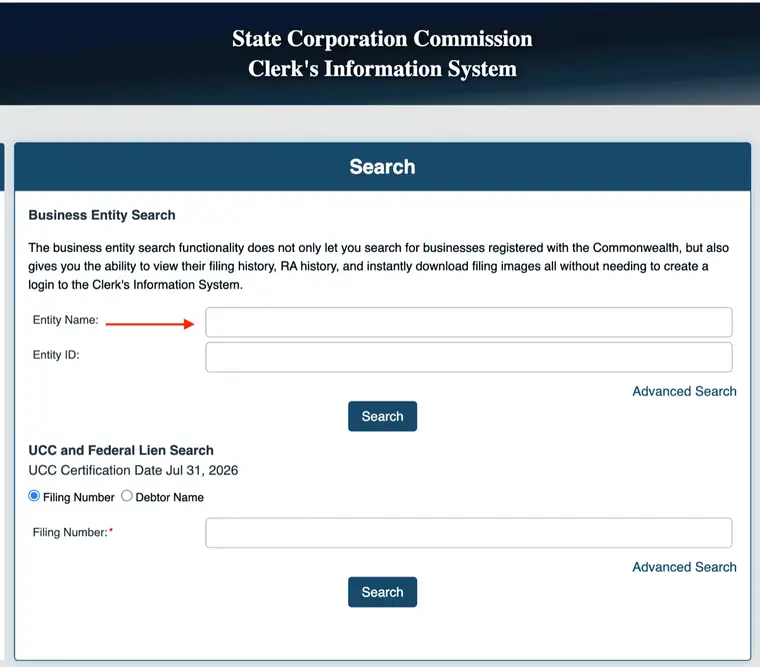
Open the Business Entity Search. After the cookie notice, the Search panel offers two fields, Entity Name and Entity ID, with an Advanced Search link for narrower passes. The section below it, UCC and Federal Lien Search, is a different register for secured-lending filings; entity names live in the top panel. The intro text above the fields is the page describing its own scope, filing images included.
Step 2: Type the distinctive words and press Search
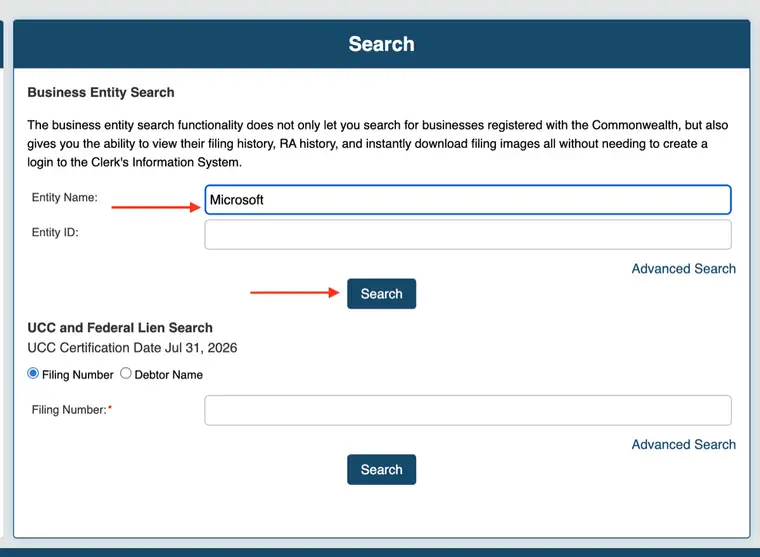
Type the words that make your name yours into Entity Name, without the ending, because § 13.1-1012 reads “limited company,” “limited liability company” and their abbreviations as designators rather than as the name, and press Search. Leave Entity ID empty; it is for pulling one known record by its number.
Step 3: Read Name Type, Entity Type and the Series LLC column
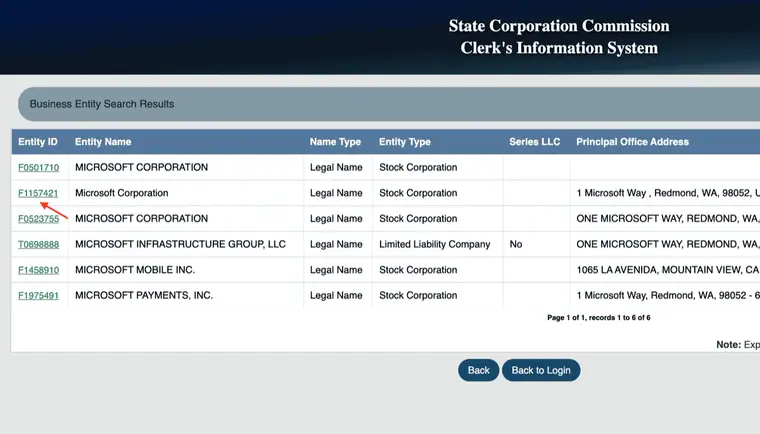
The results carry Entity ID, Entity Name, Name Type, Entity Type, Series LLC and Principal Office Address. Two things stand out. The same legal name can appear on several rows, because Virginia keeps old records visible; this capture holds three separate MICROSOFT CORPORATION records with different entity IDs. And the Series LLC column exists because Virginia recognizes protected series, each needing a name of its own; an ordinary LLC shows a plain No there. A repeated name is not double counting, it is history, and the next step is how you tell which row is alive.
Step 4: Open the record and read Status with its Reason
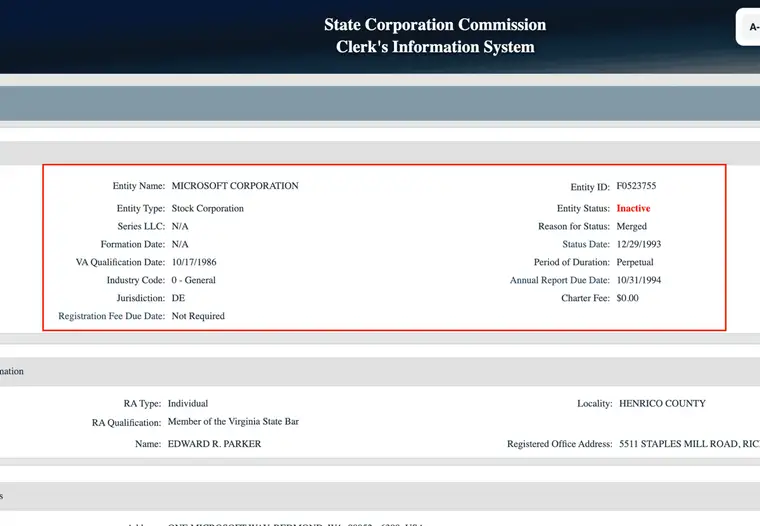
The detail screen pairs Entity Status with a Reason for Status and a Status Date, so an old record explains itself: this one reads Inactive, Merged, 12/29/1993. VA Qualification Date shows when a foreign company registered here, distinct from its formation at home, and Jurisdiction names the home state. The Registered Agent block carries a Virginia signature: RA Qualification, because Virginia requires an individual agent to be either a member of the Virginia State Bar or part of the company’s own management. The one in this record is the former.
Virginia LLC naming rules
The rules are in Va. Code § 13.1-1012:
- Required ending: “limited company” or “limited liability company,” or the abbreviations “L.C.,” “LC,” “L.L.C.” or “LLC.”
- No borrowed identities: the name may not state or imply that the company is a corporation, a limited partnership, a registered limited liability partnership, or a protected series of a series LLC.
- The comparison set: distinguishable on the Commission’s records from every domestic and registered foreign LLC, corporation, business trust and limited partnership, and from the names reserved or registered for those entity types.
- What is not in the set: assumed and fictitious names. Subsection (E) keeps Title 59.1’s DBA system outside the entity-name screen entirely.
- The consent route asks a lot: the Commission can authorize a non-distinguishable name only when the other entity consents in writing and files an undertaking, in a form satisfactory to the Commission, to change its own name to something distinguishable.
- Regulated words: “bank” and “trust” need clearance from the Bureau of Financial Institutions, and certain professional terms need the relevant board’s approval, under statutes outside § 13.1-1012.
Reserving a name in Virginia
A reservation is $10 on Form SCC631 and holds the name for 120 days.
The renewal mechanics deserve the attention here. § 13.1-1013 lets the reservation renew for successive 120-day periods at the same $10, but only when the renewal is filed during the 45-day window before expiration. File too early or let the date pass and the hold lapses. A reserved name can also be transferred by a signed notice specifying the transferee’s name and address, so a name someone else is holding can be bought rather than waited out.
Assumed or fictitious names in Virginia
Virginia rebuilt this system on January 1, 2020: every certificate of assumed or fictitious name is now filed centrally with the Commission for $10, replacing the old filings spread across the circuit courts of 133 localities. The certificate never expires; when the name is retired, the filer records a certificate of release.
What makes Virginia unusual is what the filing does not do. Under § 13.1-1012(E), assumed names sit outside the entity-name comparison, so a registered fictitious name blocks nothing and is blocked by nothing on the entity side. The certificate is disclosure, searchable in the same system, and that is all. Whoever relies on a trade name here protects it with a trademark, not with the register.
If your Virginia name is taken
- Confirm the row is alive before negotiating. The results keep inactive records visible; the detail screen’s Status, Reason and Status Date say whether the conflict is a company or a memory.
- A DBA is never the blocker. If the matching record is an assumed or fictitious name, § 13.1-1012(E) says it does not enter the comparison; your filing can proceed, and your remaining risk is trademark law.
- Consent means the other company renames itself. Virginia’s consent route requires a written undertaking to change the consenting entity’s own name, filed with the Commission. A holder unwilling to rename cannot wave you through.
- A protected series needs its own clear name. If you are structuring a series LLC, each protected series faces the same distinguishability test the parent does.
- A held name can be transferred. A reservation moves by signed notice under § 13.1-1013, so the $10 hold in someone else’s hands is negotiable.
If the search comes back clear, you can start your Virginia LLC with that name. The Articles of Organization are $100 on Form LLC1011, and the register you just searched stays useful after formation: the Clerk’s Information System hands over any company’s filing images free, without a login.
Official Virginia sources
- Clerk’s Information System search: the Commission’s records, filing history and filing images
- Va. Code § 13.1-1012: the designator, the comparison set, the consent undertaking and subsection (E)
- Va. Code § 13.1-1013: the 120-day reservation, its 45-day renewal window and transfer
- SCC forms and fees for LLCs: the $100 Articles of Organization and $10 reservation
- Va. Code § 59.1-70: the centralized $10 certificate of assumed or fictitious name
Frequently asked questions
How do I check business name availability in Virginia?
Search the State Corporation Commission's Clerk's Information System, whose search page states its own scope: you can search registered businesses, view their filing history and registered agent history, and download filing images, all without creating a login. Enter the distinctive words in Entity Name and press Search. What you find is preliminary; the Commission decides the name when it reviews your Articles of Organization.
What does Virginia compare my LLC name against?
Va. Code § 13.1-1012 requires the name to be distinguishable on the Commission's records from every domestic and registered foreign LLC, corporation, business trust, and limited partnership, plus the names reserved or registered for those entity types. Assumed and fictitious names are not on that list: § 13.1-1012(E) keeps them outside the screen, so a DBA never blocks an entity name in Virginia.
How much does it cost to reserve a business name in Virginia?
The reservation is $10 on Form SCC631 and holds the name for 120 days. It renews for successive 120-day periods at the same $10, but only if the renewal is filed during the 45-day window before expiration, so the renewal date is worth a calendar entry. A reserved name can be transferred by a signed notice naming the transferee.
Do Virginia DBAs show up in a business name search?
They are searchable but they do not block. Since January 1, 2020 every certificate of assumed or fictitious name is filed centrally with the Commission for $10 and appears in the Clerk's Information System. But § 13.1-1012(E) keeps assumed names out of the entity-name comparison, so a fictitious name cannot stop your LLC name and your LLC name cannot stop someone's fictitious name. Trademark law, not the register, is the remaining risk.
Why do decades-old companies still appear in the results?
The Clerk's Information System keeps inactive records visible and tells you why they are inactive. A record's detail screen pairs Entity Status with a Reason for Status and a Status Date, so a company can read Inactive, Merged, 12/29/1993. Read the status before treating a row as a conflict; the Commission's comparison runs against its active records, and the detail screen is where a row's real state lives.