
Washington Business Name Availability Checker
Data verified July 25, 2026 · Official database: Washington Secretary of State
LLC filing fee
Name reservation cost
Reservation hold nonrenewable
Quick answer: Washington keeps every business type in one naming register under the Uniform Business Organizations Code, so an LLC name is measured against corporations, partnerships and nonprofits in the same sweep, and you check it in the Secretary of State’s Corporations and Charities Filing System. Two things follow that catch people out. Consent from the other company is not enough here: RCW 23.95.300 also requires that company to undertake to change its own name. And trade names are not in this system, because Washington registers those at the Department of Revenue.
How to check a name in Washington
The checker above is your quick first pass. The four screens below follow the Corporations and Charities Filing System, known as CCFS, which is where every Washington entity record lives. It opens on a form built for narrowing rather than for guessing, and its results carry a number you will use again later. What you find is preliminary; the Secretary of State decides the name when your Certificate of Formation is reviewed.
Step 1: Open the Advanced Business Search
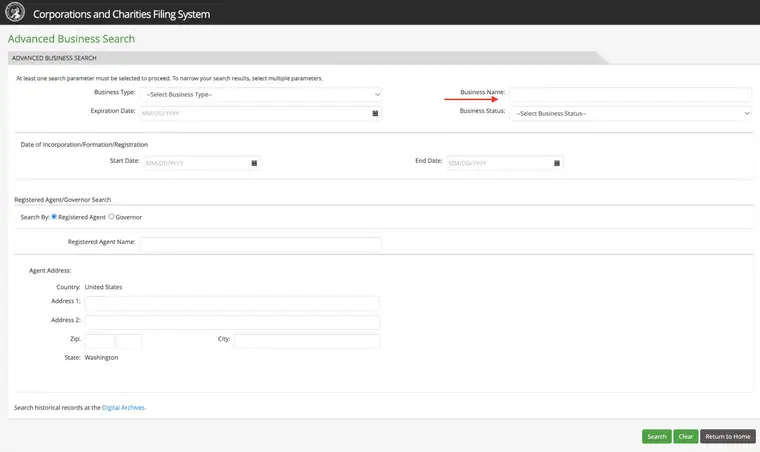
Open CCFS and choose the Advanced Business Search. The page states its one rule at the top: “At least one search parameter must be selected to proceed. To narrow your search results, select multiple parameters.” Alongside Business Name sit Business Type and Business Status dropdowns, a formation Start Date and End Date pair, and a Registered Agent/Governor Search block. For a name check, leave the filters alone. Narrowing by type would hide exactly the records you need to see.
Step 2: Search the words on their own
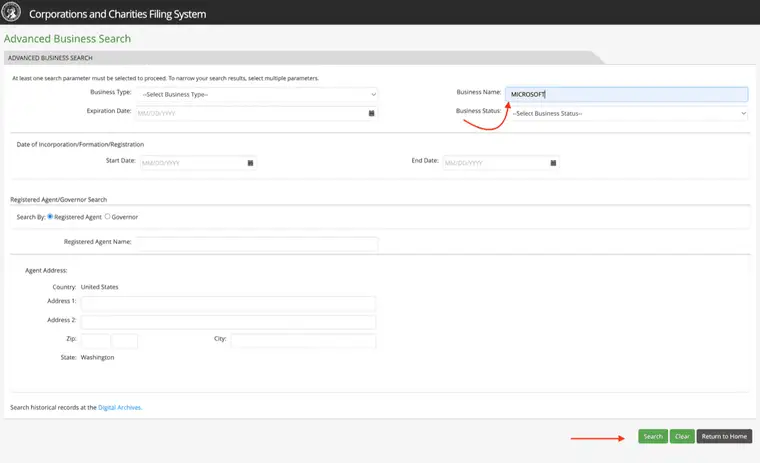
Enter the distinctive words in Business Name and stop there. Do not add “LLC”: Washington disregards entity-type wording when it compares names, and RCW 23.95.305 bars “Corp.,” “Inc.,” “Ltd.,” “LP” and “LLP” from an LLC name in the first place. Resist the Business Status dropdown too, because an inactive-looking record may still block you and you want to read its exact status yourself. Choose the green Search button.
Step 3: Read the exact status word
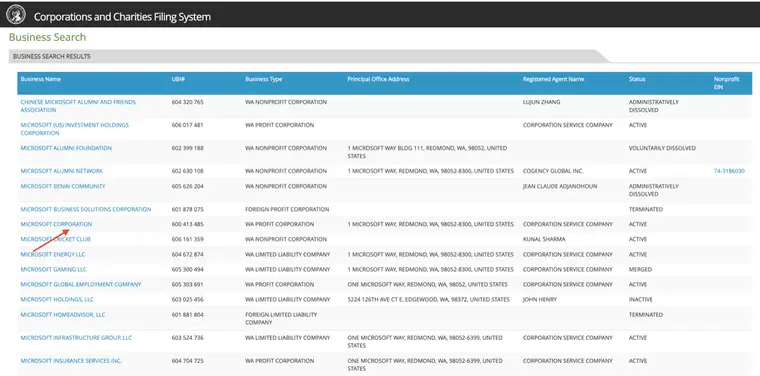
The results table carries Business Name, UBI#, Business Type, Principal Office Address, Registered Agent Name, Status and a Nonprofit EIN column. The type column mixes WA PROFIT CORPORATION, WA NONPROFIT CORPORATION, WA LIMITED LIABILITY COMPANY and FOREIGN LIMITED LIABILITY COMPANY rows, which is the shared register working as designed. Read Status word for word rather than at a glance: Washington writes ACTIVE, ADMINISTRATIVELY DISSOLVED, VOLUNTARILY DISSOLVED, TERMINATED, MERGED and INACTIVE as separate states, and the statute carves out only the administratively dissolved. “Dissolved” alone tells you nothing.
Step 4: Open the record and its name history
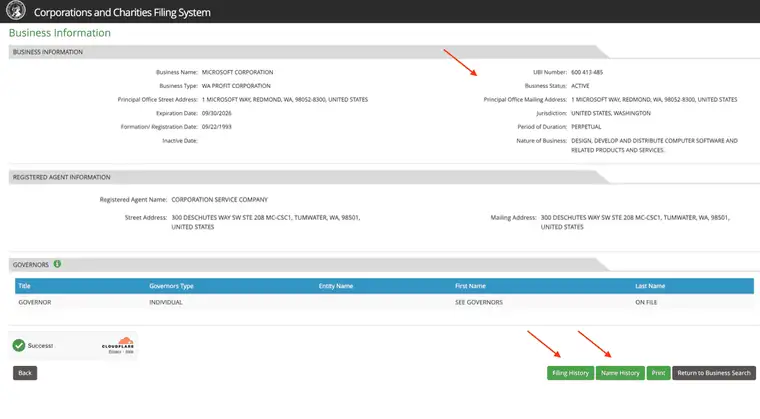
Business Information gives you the UBI Number, Business Status, Business Type, Formation/Registration Date, Jurisdiction, Period of Duration and a Nature of Business line, plus registered agent details and a Governors table. Two fields repay attention. Expiration Date is the annual-report deadline, so a live record can still be weeks from lapsing. And the Name History button at the foot of the page lists names the company has used before, which the results list never shows.
Washington LLC naming rules
The rules sit in the Uniform Business Organizations Code, at RCW 23.95.305 and RCW 23.95.300:
- Required ending: “limited liability company,” or “limited liability” with “Co.,” or “L.L.C.” or “LLC.”
- Other entity words are barred: “Cooperative,” “partnership,” “corporation,” “incorporated,” “Corp.,” “Ltd.,” “Inc.,” “LP,” “L.P.,” “LLP,” “L.L.P.,” “LLLP” and “L.L.L.P.” may not appear, along with anything another Washington statute prohibits.
- One register for everything: the comparison runs against domestic entities of any type that are not administratively dissolved, foreign entities registered here, names reserved under RCW 23.95.310 and names registered under RCW 23.95.315.
- Entity type does no work: a name is not distinguishable merely because it ends “LLC” where another ends “Inc.” or “Corp.”
- Restricted words: “bank,” “banking,” “banker,” “trust” and “cooperative” are unavailable unless the statute protecting each one is satisfied.
- Four ways past a conflict, and the first is stricter than it looks: recorded consent from the other entity together with its undertaking to change its own name; a certified final court judgment; a merger with that entity; or formation by reorganization of it. Consent on its own does not clear the test in Washington.
Reserving a name in Washington
A reservation costs $30 and holds a name for 180 days, the long end of the national range: six times Georgia’s 30-day hold and twice Illinois’s 90. The trade-off is that it runs exactly once. It cannot be renewed, and it may be transferred only to a person that is not an individual, so it can move to a company you are forming but not to a co-founder personally.
Six months is long enough that the reservation does real work here. Against a $180 Certificate of Formation it is a sixth of the cost, and it covers the delays that actually happen: a lease that slips, a partner still exiting another business, financing waiting on a quarter end.
Trade names in Washington
Washington puts DBAs somewhere unexpected. A trade name is registered with the Department of Revenue, on the same Business License Application you use for tax registration, and not with the Secretary of State at all. Each name costs $5 and stays on file indefinitely until you ask to cancel it, with no renewal and no publication step.
The Department of Revenue is direct about what that buys: registering a trade name does not protect it from use by others. It is disclosure of who is behind a name, and the consequence cuts the opposite way from several other states. In Arizona and Illinois a registered trade name feeds the entity distinguishability screen and can block a later filing; in Washington it does not, so a clean CCFS result says nothing about who is already trading under your words. Those sit in the Department of Revenue’s Business Lookup, a separate database.
If your Washington name is taken
- Read the status word, not the row. Only administratively dissolved entities drop out of the test. VOLUNTARILY DISSOLVED, TERMINATED, MERGED and INACTIVE are different words for different situations.
- Changing the ending achieves nothing. Entity-type wording is disregarded in the comparison, and an LLC name may not carry “Inc.” or “Corp.” anyway.
- Do not count on a consent letter. Washington wants the other entity to change its own name as part of the deal, which is a far higher bar than the consent route most states allow.
- Open Name History on any close record. A company that renamed itself may still sit close to your words under a former name.
- Search the Department of Revenue separately. Trade names never appear in CCFS, so this is the half of the check the Secretary of State cannot do for you.
If both registers come back clear, you can start your Washington LLC with that name. Note the deadline the record screens showed you: every Washington entity carries an expiration date on the last day of its anniversary month, with a $70 annual report due by then.
Official Washington sources
- Corporations and Charities Filing System: the Secretary of State’s entity database
- RCW 23.95.305: required and prohibited words in an entity name
- RCW 23.95.300: the distinguishability test and the four routes past a conflict
- RCW 23.95.310: the 180-day reservation
- RCW 19.80: registration of trade names
- Filings, forms and fees: the $30 reservation and $180 formation fees
- Register trade names: the Department of Revenue’s $5 registration
Frequently asked questions
How do I check business name availability in Washington?
Search the Secretary of State's Corporations and Charities Filing System, entering your words in the Business Name field of the Advanced Business Search. Read the Status word on every close row, since Washington distinguishes ADMINISTRATIVELY DISSOLVED from VOLUNTARILY DISSOLVED, TERMINATED, MERGED and INACTIVE, and only the first of those is carved out of the statutory test. Trade names are not in this system at all, so a full check also means searching the Department of Revenue.
Why do corporations and nonprofits appear in a Washington LLC name search?
Because Washington runs one naming register for every entity type under the Uniform Business Organizations Code. An LLC name is compared against corporations, limited partnerships, nonprofits and registered foreign entities alike, which is why the results list mixes WA PROFIT CORPORATION, WA NONPROFIT CORPORATION and WA LIMITED LIABILITY COMPANY rows together. A close match of any type is worth reading.
How much does it cost to reserve a business name in Washington?
A reservation is $30 and holds the name for 180 days, one of the longest single holds in the country. It cannot be renewed, and it can be transferred only to a person that is not an individual. Forming the LLC is a separate $180 Certificate of Formation, and the annual report after that is $70.
Does registering a trade name protect it in Washington?
No. The Department of Revenue registers trade names for $5 each and states plainly that registration does not protect the name from use by others. It is disclosure of who is behind a name, not ownership, and unlike several other states a Washington trade name is not part of the Secretary of State's distinguishability screen. Protection comes from forming the entity or from a trademark.
What is the UBI number in Washington search results?
The Unified Business Identifier is the nine-digit number Washington assigns to a business and shares across state agencies, so the same number identifies the record at the Secretary of State and at the Department of Revenue. It appears as its own column in search results and on the Business Information screen, and it is the reliable way to tell two similarly named records apart.