
Wisconsin Business Name Availability Checker
Data verified July 18, 2026 · Official database: Wisconsin Department of Financial Institutions
LLC filing fee
Name reservation cost
Reservation hold renewable
Quick answer: Wisconsin names are checked in Search Corporate Records, run by the Department of Financial Institutions rather than a Secretary of State. A new LLC name must be distinguishable from the records with entity-type words ignored in the comparison, and it needs an ending such as “LLC.” Only the department’s review of your filing settles the name.
How to check a name in Wisconsin
The checker above gives you a fast first pass. The four screens below walk the department’s own search, which is worth reading closely because its landing page does something rare: it lists what the records contain and what they do not, in the state’s own words. A clean result here is a promising read, never an approval.
Step 1: Open Search Corporate Records
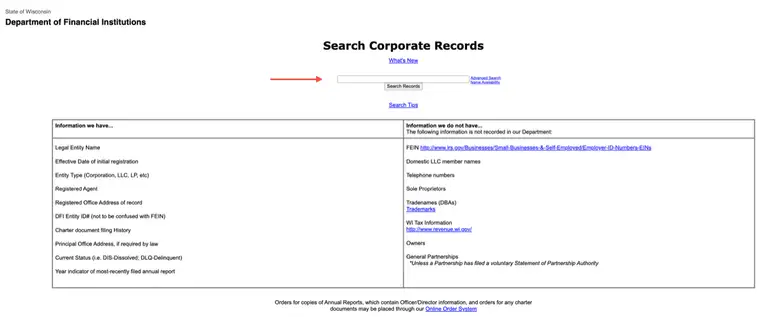
Open Search Corporate Records under the State of Wisconsin, Department of Financial Institutions. Beside the search box sit Advanced Search and Name Availability links, with Search Tips below. Read the two-column table before searching: “Information we have…” lists Legal Entity Name, Entity Type, Registered Agent, Current Status and more, while “Information we do not have…” lists FEIN, sole proprietors, tradenames (DBAs), and owners. The registry is telling you its own boundaries.
Step 2: Search the words, not the ending
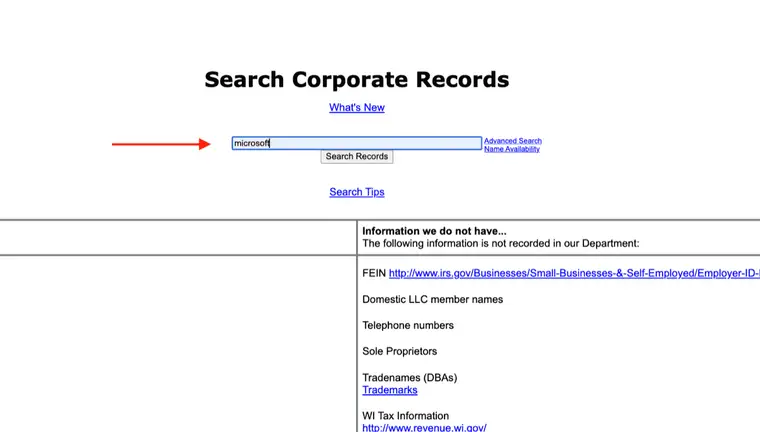
Type the distinctive words of your proposed name and press Search Records. Leave the designator off: Wisconsin ignores entity-type words when it compares names, so the ending cannot make your name different and searching without it shows you every conflict that matters. The Name Availability link beside the box asks the direct question if you prefer a verdict to a list.
Step 3: Read ID, type code, and status together
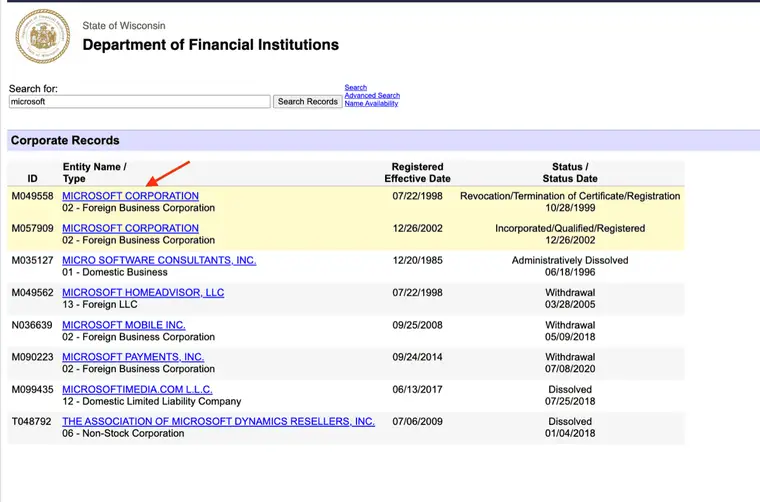
Results arrive as a Corporate Records table: ID, Entity Name / Type, Registered Effective Date, and Status / Status Date. Types read as coded labels such as “02 - Foreign Business Corporation” and “12 - Domestic Limited Liability Company.”
This search surfaced a lesson in the first two rows: MICROSOFT CORPORATION appears twice, once as a 1998 registration ending in “Revocation/Termination of Certificate/Registration” and again as a live 2002 registration. Statuses like “Administratively Dissolved,” “Withdrawal,” and “Dissolved” fill the rest of the list, and under Wisconsin’s records test an administratively dissolved entity’s name no longer blocks a filing. Open anything close to your wording.
Step 4: Confirm the record's Vital Statistics
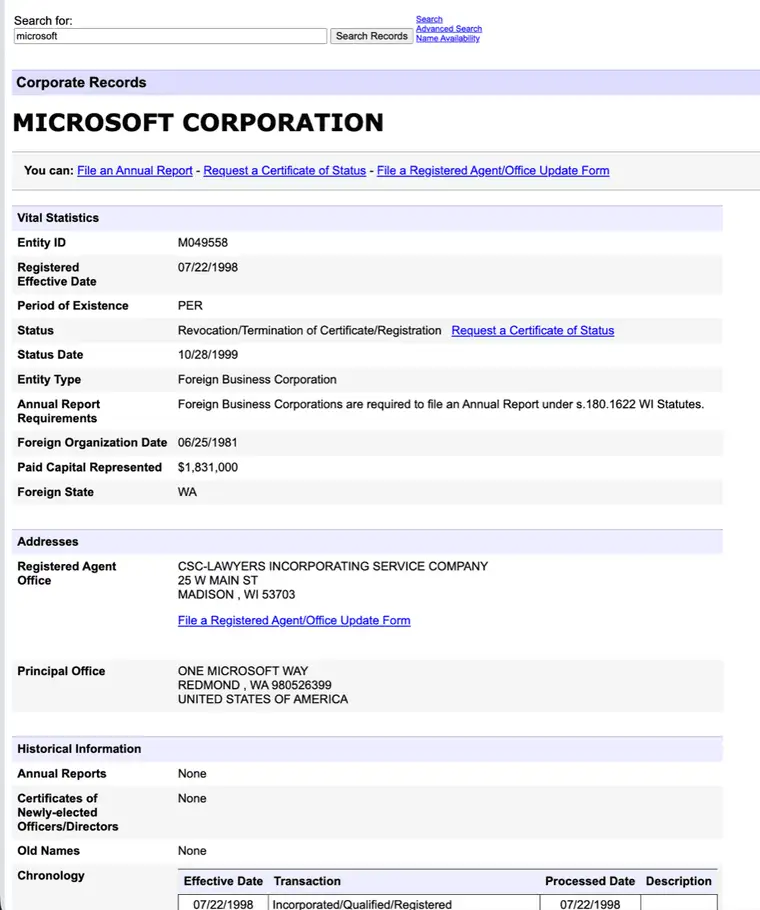
A record opens with a “You can:” action row (File an Annual Report, Request a Certificate of Status, File a Registered Agent/Office Update Form) above Vital Statistics: Entity ID, Registered Effective Date, Status with its date, Entity Type, and the annual report requirement with its statute cited. Below sit the registered agent and principal office addresses, then Historical Information with old names and a chronology of every filing. The status line is your answer: a live registration is a conflict, while a revoked or withdrawn one records when the obstacle ended.
Wisconsin LLC naming rules
Wisconsin’s rules sit in Wis. Stat. § 183.0112:
- Required ending: “limited liability company,” “limited company,” or the abbreviation “LLC” or “LC,” in any capitalization or punctuation.
- Distinguishable upon the records, with type words ignored: the comparison strips words like “LLC,” “Inc.,” “Corp.,” and “cooperative” before it runs, so two names differing only in their endings are the same name to the department. Few states write this rule down this plainly.
- Dissolved names come free sooner: the records test measures against entities that are not administratively dissolved at the time, so an administratively dissolved company’s name stops blocking without a waiting period. The opposite of states that hold dead names for a year.
- No restricted-word list: the statute instead bans language implying a purpose the company is not permitted to pursue; regulated industries police their own vocabulary.
Reserving a name in Wisconsin
A Wisconsin reservation costs $15 and holds the name for 120 days, the second-cheapest hold on this site after Hawaii’s $10. The statute allows renewal, by you or by someone the reservation is transferred to, so the clock can be restarted where most states make it run once. Forming the LLC is $130 online or $170 on paper for the Articles of Organization, and the annual report that follows is $25, due in the anniversary quarter.
With the fee this low, the reservation math changes: even a short gap between choosing a name and filing can justify $15, where a $50 hold would be a harder call.
Wisconsin trade names, the optional register
Wisconsin requires no DBA filing at all. Nothing must be recorded before trading under another name, and the search’s own landing table says tradenames and sole proprietors are not in the corporate records. What the state offers instead is optional: registration on the ch. 132 register at the Department of Financial Institutions, $15 per name or design for ten years, renewable in the six months before expiry.
The register is trademark-shaped and has real teeth: only the owner of a registered mark has standing to sue under the statute, with injunctions and damages up to three times the infringer’s profits against deceptive imitation. So while filing is never required, a Wisconsin brand worth defending is cheap to arm, and the trade name register is a separate index your corporate records search will not show.
If your Wisconsin name is taken
- Change the words, not the ending. The comparison ignores type words, so “LLC” versus “Inc.” buys you nothing. Swap or add a word with content.
- Check the status before conceding. An administratively dissolved or withdrawn record no longer blocks you, and the detail page dates the change.
- Hold a clear name for $15. With the cheapest renewable reservation in our set, there is little reason to leave a good name unprotected while formation plans settle.
If the words come back clear across your variations, you can start your Wisconsin LLC with that name while the records still read that way.
Official Wisconsin sources
- Search Corporate Records: the authoritative database
- Wis. Stat. § 183.0112: the naming statute
- Wis. Stat. § 183.0113: the 120-day renewable reservation
- DFI business entity fees: reservation and formation fees
- Wis. Stat. ch. 132: the optional trade name and trademark register
- DFI trademark online filings: the $15 ten-year registration
Frequently asked questions
How do I check LLC name availability in Wisconsin?
Search the distinctive words of your proposed name in the Department of Financial Institutions' Search Corporate Records, then read the Status column on every near match. The department also runs a dedicated Name Availability tool, linked beside the search box, for the direct question. The department decides the name for real when your Articles of Organization arrive.
Does a Wisconsin LLC name have to include "LLC"?
Yes. The statute accepts "limited liability company," "limited company," or the abbreviation "LLC" or "LC," in any capitalization or punctuation. The rarer rule sits next to it: in the distinguishability comparison Wisconsin ignores entity-type words entirely, so the ending never does the work of making a name different.
Can I name my LLC the same as an existing Wisconsin corporation?
No, and Wisconsin is stricter about this than most states. Because type words are disregarded in the records comparison, a proposed "Badger Works LLC" is not distinguishable from an existing "Badger Works Inc." The words themselves have to differ, not the suffix.
How much does it cost to reserve a business name in Wisconsin?
The department's fee is $15 for a 120-day hold, among the cheapest in the country, and the statute allows the reservation to be renewed by the applicant or a transferee. Forming the LLC costs $130 online or $170 on paper, so the reservation is a small hedge while formation plans settle.
Does Wisconsin require a DBA registration?
No. Nothing in Wisconsin law requires a filing before trading under another name, and the corporate records search itself lists tradenames and sole proprietors among the things it does not hold. What exists is optional: a $15, ten-year trade name or trademark registration under ch. 132, which carries real remedies once registered.